
- Chennai
- Tamil Nadu
- India
- World
- EntertainmentEntertainment
- Business
- Sports
- Lifestyle
- Technology
- Videos
- Explainers
- Editor's Picks

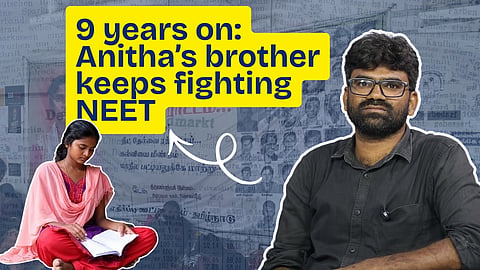
CHENNAI: Nine years ago today, news of 17-year-old Ariyalur student S Anitha’s suicide had begun trickling in. By then, the Dalit girl who had taken her fight against the National Eligibility cum Entrance Test (NEET) all the way to the Supreme Court had become a familiar face across Tamil Nadu. Determined to become a doctor, she did not let the implementation of NEET for admission to medical colleges stop her from fighting for her dream.
Under the Tamil Nadu State Board, she had scored an exceptional 1,176 out of 1,200, with a medical cut-off of 196.75 out of 200 — scores that would have secured her a medical seat in the state, under the previous admission criteria. She wrote countless letters, spoke in videos, and participated in protests, seeking an exemption for TN students from NEET for that academic year.
Anitha was born after four sons, the answer to her parents’ prayers for a daughter they had longed for. Her older brother, S Manirathinam (36), recalls, “Paapa always got the first rank.”
Their mother died when Anitha was seven, after which their paternal grandmother helped raise them. Their father worked as a load carrier at Tiruchy’s Gandhi Market to educate them. “But because we had ration rice, we did not have to experience hunger,” says Manirathinam, a Bcom and MBA graduate.
Understanding the family’s circumstances, Anitha never demanded anything for herself. The only thing she was invested in was her education. Once, even after breaking her hand, she went to school as usual. When the headmistress asked why she had come, Anitha replied, “I only have to listen (to the class) with my ears, no?”
After she finished Class 10 in a school in Kuzhumur, Manirathinam enrolled her at a school 18 km away, one with a hostel as they did not have toilets at home. At the time, instead of pressuring her over marks, he advised: “Marks don’t determine our intelligence. But you have to study with your goal in mind; only then can you enrol in your desired course.”
When the Class 12 State Board results were announced in May that year, Anitha passed with flying colours, scoring 1,176 out of 1,200, including double centums in Mathematics and Physics. Manirathinam was overjoyed, but knew NEET could pose a hurdle. He applied for aeronautical engineering at MIT and veterinary science in Orathanadu, and she secured both seats but did not take them up. For Anitha, becoming a doctor was her only dream.
Anitha passed Class 12 exam with flying colours, scoring 1,176 out of 1,200, including double centums in Mathematics and Physics. Manirathinam was overjoyed, but knew NEET could pose a hurdle. She had applied for aeronautical engineering at MIT and veterinary science in Orathanadu, and secured both seats but did not take them up. For Anitha, becoming a doctor was her only dream
That year, NEET had become mandatory for medical admissions after states were granted a one-year exemption in 2016. Anitha had scored 86 out of 720 marks when its results were declared in June.
In July that year, Manirathinam invited Anitha to an anti-NEET protest in Ariyalur, asking her to just come and observe. There, they met DMK’s Ariyalur district secretary SS Sivasankar and told him about her plight. Sivasankar strongly raised the issue and also introduced her to the media after she became a household name.
At the heart of their protest was a simple argument: a Class 12 student had studied a syllabus prescribed by the government, written an exam conducted by the government and proved her ability through the marks awarded by the same system. Until the previous year, medical admissions had been based on those Class 12 marks. “So why not admit her through the same system?” they asked then.
The family met political leaders, including the then Leader of the Opposition, MK Stalin, seeking support, even as anti-NEET protests continued across Tamil Nadu. There was a brief moment of hope in August. Union Minister Nirmala Sitharaman said that the Centre would consider a one-year exemption for Tamil Nadu, and the Union Law Ministry cleared the State government’s draft ordinance.
On August 17, Anitha, represented by her father as she was still a minor, filed an affidavit in the Supreme Court, when several pro-NEET students had also approached the court. The State government had initially reserved 85% of State quota medical seats for State Board students. But the Madras High Court struck down the order after CBSE students challenged it as discriminatory.
“We thought even a 50-50 split of seats between CBSE and State Board students would get us a seat,” Manirathinam says. “But on August 22, the Union government gave a cruel blow to TN students by backing away from the ordinance seeking a one-year exemption from NEET.”
Attorney General KK Venugopal, who had initially given the proposal the nod, reversed his position, saying the ordinance would not stand legal scrutiny. The Centre then told the Supreme Court that admissions would have to be conducted solely on the basis of NEET. The NEET merit list was released the following day, and admissions began.
Meanwhile, Manirathinam urged his sister not to lose a year and suggested she could prepare for NEET alongside college. He had been working in the share market and preparing for UPSC, but he left his job when it was time for Anitha’s college counselling sessions.
But on the fateful day of September 1 that year, Anitha died by suicide at home. “We were all away from home that day. We don’t know what she was thinking. Paapa had seemed happy; she never told me she was upset. I had taken her to protests and even to the Supreme Court because I wanted to make sure she would never regret not having at least tried to fight.”
The revised NEET PG cut-offs allow even those with negative marks to enter counselling. If a person can get a seat without effectively qualifying in the exam, then why keep NEET in the first place?
S Manirathinam, brother of Anitha
Earlier this year, a remark by Chief Justice Surya Kant, who referred to sections of unemployed youth as “cockroaches” and “parasites” during a hearing in May, triggered the formation of the Cockroach Janta Party (CJP), led by its founder, Abhijeet Dipke.
The movement soon took up the 2026 NEET paper leak, amid widespread anger over such entrance exam irregularities affecting millions.
Manirathinam says the movement drew him in because it echoed questions TN had raised nine years earlier. At the Jantar Mantar protest, he called for NEET to be scrapped and education moved from the Concurrent List back to the State List.
“When TN protested then, it was largely fighting a system alone. What TN was saying years ago, India is now speaking about collectively,” he says.
Manirathinam argues that NEET’s impact extends beyond access to medical education, affecting Tamil Nadu’s public healthcare system. “Those spending lakhs to study medicine are unlikely to come from villages or serve in rural health centres. That will affect PHCs and, in turn, government hospitals,” he says. “The recent return of around 150 unfilled in-service quota PG medical seats could have strengthened government super-speciality hospitals.”
Referring to the revised NEET PG cut-offs, which allow even those with negative marks to enter counselling, he asks: “If a person can get a seat without effectively qualifying in the exam, then why keep NEET in the first place?”
In the days that followed, protests demanding #JusticeForAnitha erupted across Tamil Nadu and continued for weeks, with even school students joining demonstrations. Tamil Nadu passed two Bills seeking exemption from NEET in February 2017, but the President withheld assent in September, days after Anitha’s death — a decision that became public only in 2019.
After coming to power in 2021, the DMK set up the AK Rajan committee, which found a decline in the proportion of first-generation, rural and Tamil-medium students entering medical colleges after NEET. The State government subsequently passed another exemption Bill, which was rejected by the President in 2025, prompting the State to move the Supreme Court.
Questioning the veto, Manirathinam asks, “States, too, can legislate on matters in the Concurrent List, and there are provisions to resolve conflicts with the Centre. But if the Centre will never assent to States’ decisions, why have a Concurrent List at all? The State and Union Lists alone would be enough, wouldn’t they?”
Speaking of the TVK-led government’s recent Assembly resolution against NEET, Manirathinam calls it just a beginning. “The next step,” he argues, “should be to bring together all parties and anti-NEET voices, including Chief Ministers from other states.”
Financial constraints kept Manirathinam away from many protests after 2017. But after returning from the CJP march in New Delhi, he joined the sit-in at the CPI’s Balan Illam in Chennai. “A lot of us at Balan Illam did not want the protest to end just because the Delhi protests had ended. I realised there that the movement had to continue.”
In August, the Anti-NEET Federation-Tamil Nadu, led by him, held a 12-day hunger strike in Koyambedu and met government representatives. They are still seeking a larger designated venue for their protests. “The gathering drew many young people. We have to uphold their trust in us,” he says. “It is a challenge because I have to hold onto my job, too. But I feel I have to take forward what Anitha started.”
Manirathinam, who now works in Chennai, has since been running the Anitha Memorial Library set up on their land in the village, where he earlier conducted free UPSC coaching classes. Along with him, student organisations and other activists are planning signature campaigns and protests in September, while the TSYF and other groups will observe Anitha’s ninth memorial day at Besant Nagar Beach on September 1.