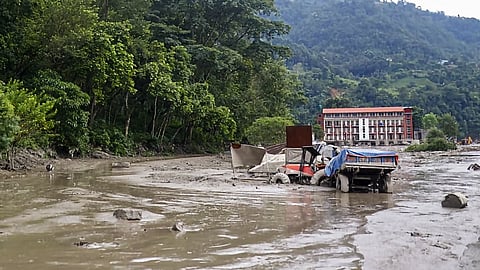


KATHMANDU: The death toll in the massive flash floods in Nepal rose to 177, as authorities in Nepal on Thursday race against time to find hundreds of missing people, including 300 Indian tourists, in one of the country’s worst disasters in recent years.
The flash floods on Wednesday wreaked havoc across three districts in Nepal.
Nepal Police on Thursday said that the death toll rose to 177 in the flash floods on the Bhotekoshi River after 12 more bodies were recovered.
In Rasuwa, two persons were killed, in Nuakot 12, in Dhading 27, in Chitawan 69, in Gorkha 20, in Tanhu nine, in Nawalparasi East 32 and in Nawalparasi West six, taking the total toll to 165.
Chitwan, a tourism hotspot known for its jungle safaris, is one of several municipalities that have been placed on high alert as floodwaters rise.
The flash floods were caused after an avalanche blocked the flow of the Lhende tributary of the Bhotekoshi and first hit Timure, near Nepal’s border with China at Rasuwagadhi.
Foreign Minister Shisir Khanal on Thursday said, nearly 300 Indian tourists are among thousands who are reportedly missing in the flash floods.
Khanal also confirmed that more than 160 people have died and thousands remain untraced after the tragedy in the Rasuwa region.
"Thousands of families have lost homes and are missing as of now. We are still trying to ascertain the full extent of the disaster," Khanal said.
Also, Prime Minister Balendra Shah on Thursday visited Bidur Municipality of Nuwakot district for the inspection of the flash flood affected areas. Minister for Infrastructure Development Sunil Lamshal also accompanied him during the visit, according to the Prime Minister's office.
The team left Kathmandu by road for Bidur, one of the areas hardest hit by the floods.
Prime Minister Shah has been actively overseeing rescue and relief efforts since floodwaters from the Bhotekoshi River in Rasuwa caused widespread damage in riverside settlements on Wednesday.
According to data released by the National Disaster Risk Reduction and Management Authority (NDRRMA), nearly 826 people are missing in the flash floods.
At least 44 personnel from the Nepal Army, 28 from the Nepal Police and 13 from the Armed Police Force have lost contact with the centre, authorities said.
Similarly, nearly 162 people working at different hydropower and customs offices have been missing.
As many as 579 tourists, including foreigners, are missing after the incident. Most of them were en-route to Kailash Mansarovar in Tibet and Gosainkuknda in Bagmati Province, Nepal, officials said.
So far, 73 people have been found injured in the flood related incidents, which includes 43 from Rasuwa, 27 from Nuwakot and 3 from Dhading. They are undergoing treatment at different hospitals, including Tribhuvan University Teaching Hospital in Kathmandu.
The floods have damaged 35 motorable bridges, 45 suspension bridges, and 40 km of black-topped road, mainly in central Nepal. Among 123 stranded people rescued from Timure area of Rasuwa, 94 were Nepalese and 29 were foreigners, according to NDRRMA.
A preliminary assessment on Thursday suggested that the flash flood was caused by an ice avalanche upstream blocking a river on the Nepal–China border, Disaster Management authorities were quoted as saying by My Republica.
The assessment suggests that the flood in the Trishuli River was caused by an ice avalanche upstream blocking the Lendhe River.
The NDRRMA said that a debris-laden flood occurred in the Lendhe River following an ice-rock landslide at the Nepal–China border, about 20 kilometres northeast of Rasuwagadhi.
"The same flood appears to have entered the Trishuli River after passing through Timure,” the authority said, amid various theories and assessments regarding the cause of the flood, which has now become a recurring issue.
Disaster expert Basanta Raj Adhikari also argues that an ice avalanche occurred in the Lendhe River, about 20 kilometres upstream of Rasuwagadhi, blocking the river and causing the flooding, My Republica reported on Thursday.
In some places, the collection of mud and rocks has blocked the road, while in other places transportation has been halted due to possible risks associated with the flood.
A section of the national highway from Nagdhunga in Kathmandu to Mugling has been completely halted for an indefinite period.
This is the main highway connecting Kathmandu with outside districts. Similarly, transport service has been halted on the Mechi Highway of Ilam district, the BP Highway of Kavre, the Kanti Lokpath of Makwanpur, the national highway of Rasuwa, the national highway of Nuwakot, the Prithvi Highway of Dhading, national highway connecting Chitwan and Jajarkot Dolpa road section in Rukum West.
Based on the scale of those unaccounted for, security officials and disaster experts have said that the flash floods may rank among the deadliest in Nepal’s modern history, potentially surpassing every disaster since the 1993 floods in Sarlahi, Rautahat and Makawanpur, which killed 1,400 people and have long stood as the country’s benchmark disaster.