- Chennai
- Tamil Nadu
- India
- World
- EntertainmentEntertainment
- Business
- Sports
- Lifestyle
- Technology
- Videos
- Explainers
- Editor's Picks

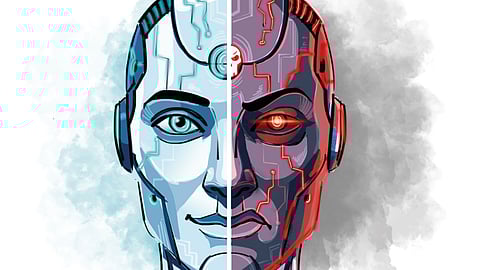
CHENNAI: A new artificial intelligence (AI) model named Claude Mythos, which has been developed by OpenAI’s chief rival Anthropic, has revolutionised the way AI performs and has triggered urgent concern among IT firms, governments, banks and top financial regulators worldwide.
While the general-purpose frontier model has not been publicly released yet, it is touted to have powerful capabilities to find and exploit security flaws in common software that have evaded being found for decades, raising serious cybersecurity alarms.
Mythos Preview has already found thousands of high-severity vulnerabilities, including some in every major operating system and web browser, the US-based Anthropic said in a recent blog post.
Claude Mythos is an advanced large language model (LLM) which has been designed to perform beyond simple text generation.
According to initial reports, Anthropic claims that the model can identify and then exploit security vulnerabilities in every major operating system and web browser as per the user’s command. In what can be described as a mind-blowing USP of the model, the dual capability of playing both offensive and defensive makes it a powerful but risky tool.
When put to use across different softwares, Claude Mythos had the capability to identify bugs even in the most secure softwares within a matter of hours. While this feature could be a boon to developers if used ethically, the core concern remains that such intelligence, when it falls into the wrong hands, can wreak havoc.
For example, hackers could use it to discover unknown weaknesses called ‘zero-day vulnerabilities’ in widely used software that human experts could have missed. This could lead to cyberattacks on a scale that has never been seen before.
As Mythos can identify decades’ worth of vulnerabilities within hours without human intervention, Anthropic has restricted early access due to potential risks. Under its ‘Project Glasswing’, backed by a $100 million budget, access to Mythos Preview is limited to firms like Amazon, Apple and JPMorgan Chase, along with over 40 organisations managing critical software infrastructure to scan and secure systems.
The aim is to patch vulnerabilities before similar models emerge. The potential fallout for economies, public safety and national security could be severe, making Project Glasswing a defensive effort, Anthropic noted.
While major banks are considered to be the pillars behind the global financial system, following the invention of Claude Mythos, there is growing concern that banks may be vulnerable to cybersecurity attacks.
A well-executed AI-driven cyberattack on one of them could cause financial repercussions across the world and financial markets. Following this, major banks are in discussion over how they can brace themselves against such attacks and help secure their critical systems.
While Claude Mythos is still in an extremely nascent stage, as Anthropic said, it is just the beginning and not the ceiling. It may be noted that the firm also said that this particular model has the capability to surpass most skilled humans in finding and exploiting software vulnerabilities.
As of now, the Electronics and Information Technology Ministry in India is actively studying the implications of Claude Mythos and assessing what it could mean for the country’s digital infrastructure, as government IT systems such as UPI, Aadhaar and GST could be vulnerable to attacks.
In another tangent, many cybersecurity firms are scrambling to cement their spot after the news of Claude Mythos hit the market. While many have raised concerns that if an AI model can outperform them in finding cyber vulnerabilities, it could spell doom for them as a sector. It may be noted that cybersecurity companies are also facing the heat in the stock market, as the numbers took a beating after the announcement of the new AI model.
Responding to these concerns, Anthropic has said that Claude Mythos is not here to disrupt but is a tool to enhance existing security systems and make them more productive.
A well-executed AI-driven cyberattack on one of them could cause financial repercussions across the world and financial markets.