
- Chennai
- Tamil Nadu
- India
- World
- EntertainmentEntertainment
- Business
- Sports
- Lifestyle
- Technology
- Videos
- Explainers
- Editor's Picks

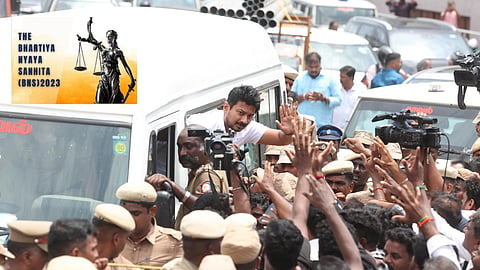
CHENNAI: Leader of Opposition Udhayanidhi Stalin was taken for questioning by the police on Tuesday (August 4) in connection with case registered against him over his purportedly derogatory remarks against actor Trisha while attacking Chief Minister C Joseph Vijay.
The Thanjavur Police registered the case against him under six sections of provisions of the Bharatiya Nyaya Sanhita (BNS). The police have also invoked relevant sections from the Tamil Nadu Prohibition of Harassment of Women (Amendment) Act and the Information Technology Act.
The case has triggered political controversy, with the DMK moving the Madras High Court seeking anticipatory bail after the registration of the FIR.
Here are the provisions invoked in the case and the punishments prescribed:
The BNS defines criminal conspiracy as an agreement between two or more persons to commit an illegal act or a legal act through illegal means. Section 61 deals with criminal conspiracy to commit an offence punishable with death, imprisonment for life or rigorous imprisonment for a term of 2 years or upwards. It can be bailable or non-bailable depending on the object of the conspiracy, and the trial will be done by a judicial officer based on the nature of the conspiracy.
If the conspiracy relates to serious offences punishable with death, life imprisonment, or rigorous imprisonment of two years or more, the punishment is the same as for abetment of that offence. For lesser offences, punishment may extend to six months' imprisonment, or a fine, or both.
Section 79 deals with uttering words or making any gesture or doing any acts intended to insult the modesty of a woman, etc. It is a bailable offence, and can be tried by any magistrate.
The prescribed punishment is simple imprisonment for up to three years along with a fine.
Section 192 relates to wantonly giving illegal provocation with the intent to cause a riot. The offence is bailable. Case to be tried by any magistrate.
If a riot is committed as a consequence of the provocation, the punishment is imprisonment of up to one year, or a fine, or both. If no riot takes place, the punishment may extend to six months, or a fine, or both.
Section 196 deals with promoting enmity between different groups on grounds such as religion, race, place of birth, residence, language, caste, or community, and acts prejudicial to the maintenance of harmony. Case to be tried by magistrate of the first class.
The offence is non-bailable, and is punishable with imprisonment for up to three years, or a fine, or both. If committed in a place of worship or during a religious ceremony, the punishment can extend up to five years along with a fine.
Section 296(b) penalises singing, reciting, or uttering obscene songs, ballads, or words in or near a public place causing annoyance to others. It is a bailable offence, and can be tried by any magistrate.
The offence carries a maximum punishment of three months' imprisonment, a fine of up to Rs 1,000, or both.
Section 351(2) deals with criminal intimidation by threatening injury to a person's body, reputation, or property, or that of someone they care about, with the intention of causing alarm or compelling an illegal act. It is a bailable offence and can be tried by any magistrate.
The punishment is imprisonment for up to two years, or a fine, or both.
Section 352 deals with intentional insult intended to provoke breach of peace. It is a bailable offence. Case to be tried by any magistrate.
The offence is punishable with imprisonment for up to two years, or a fine, or both. It is a non-cognisable offence triable by any Magistrate.
Whoever commits or participates in or abets harassment of women in or within the precincts of any educational institution, temple or other place of worship, bus stop, road, railway station, cinema theatre, park, beach, place of festival, public service vehicle or vessel, or any other place shall be punished with imprisonment for a term which may extend to three years and with fine which shall not be less than Rs 10,000.
Whoever publishes or transmits or causes to be published or transmitted in the electronic form, any material which is lascivious or appeals to the prurient interest or if its effect is such as to tend to deprave and corrupt persons who are likely, having regard to all relevant circumstances, to read, see, or hear the matter contained or embodied in it, shall be punished on first conviction with imprisonment of either description for a term which may extend to three years and with fine which may extend to Rs 5 lakh, and in the event of second or subsequent conviction with imprisonment of either description for a term which may extend to five years and also with fine which may extend to Rs 10 lakh.