
- Chennai
- Tamil Nadu
- India
- World
- EntertainmentEntertainment
- Business
- Sports
- Lifestyle
- Technology
- Videos
- Explainers
- Editor's Picks

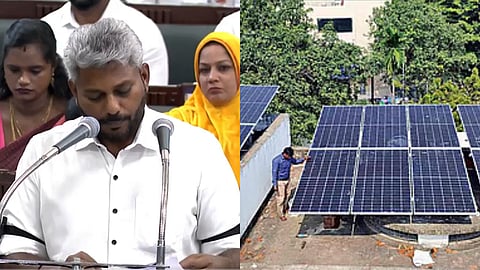
CHENNAI: Finance Minister N Marie Wilson on Wednesday announced that smart meters will be installed for all electricity consumers in Chennai, alongside a new rooftop solar subsidy scheme offering up to Rs 1 lakh for households and financial support for Resident Welfare Associations (RWAs) to install electric vehicle (EV) charging stations in residential complexes.
Presenting the first Budget of the Tamilaga Vettri Kazhagam (TVK) government in the Assembly, the minister said the new Rooftop Solar Subsidy Scheme would be implemented in convergence with the Pradhan Mantri Surya Ghar Muft Bijli Yojana. Under the scheme, domestic consumers will receive a subsidy of up to Rs 1 lakh to install rooftop solar panels, helping reduce their electricity bills and supporting the transition to renewable energy. An allocation of Rs 50 crore has been made for the scheme.
The Budget also proposed installing smart meters for all consumers in Chennai and for 50 lakh industrial and commercial consumers across the rest of the State. The announcement marks a departure from the previous government's plan to install 3.04 crore smart meters for all consumers in two phases. Under that proposal, the first phase covered 1.44 crore smart meters for all low-tension three-phase consumers, single-phase consumers with bi-monthly consumption above 400 units, all high-tension (HT) consumers and distribution transformers, while the remaining consumers were to be covered in the second phase after successful completion of the first. The phased rollout was also expected to delay the implementation of monthly electricity billing.
To promote electric mobility, the government announced that 20,000 public EV charging stations would be established over the next five years through the public-private partnership (PPP) mode, with Rs 50 crore allocated in the current financial year. It also announced a Rs 5 crore subsidy scheme for RWAs to install EV charging stations in residential complexes.
The government also proposed constructing 178 new substations at a cost of Rs 1,543 crore and replacing 40,000 ageing transformers in phases with an investment of Rs 2,000 crore.
The Budget announced major transmission projects, including the Rs 4,000 crore Coimbatore-Ariyalur 765 KV transmission line under the PPP mode, strengthening ultra-high voltage transmission infrastructure in Chennai and surrounding areas at a cost of Rs 1,390 crore, expediting the Rs 1,187 crore Green Energy Corridor Phase II and the Rs 1,640 crore Virudhunagar-Coimbatore 765 KV transmission project, besides securing financial assistance for the Rs 6,884 crore Phase III of the Green Energy Corridor project, which will be capable of evacuating 11,760 MW of renewable energy.
To address rising electricity demand, projected to exceed 37,000 MW by 2035-36, the government will introduce a new Battery Energy Storage System (BESS) Promotion Policy to attract private investment and position Tamil Nadu as India's "BESS Hub".
The government said the power sector would play a key role in achieving Tamil Nadu's vision of becoming a $1.5 trillion economy by 2036. It announced that the Udangudi Stage I and Ennore SEZ thermal power projects, together adding 2,640 MW of generation capacity, would be expedited. The Rs 8,000 crore Ennore Thermal Power Station Expansion Project will be implemented through the PPP mode, while the Rs 5,050 crore Vellimalai Pumped Storage Hydroelectric Project will also be fast-tracked.
The Budget allocated Rs 1,545 crore towards increasing the free electricity entitlement from 100 units to 200 units for domestic consumers with bi-monthly consumption of up to 500 units. It also earmarked Rs 18,860 crore for electricity subsidies, Rs 5,000 crore as compensation to the Tamil Nadu Generation and Distribution Corporation, and Rs 15,828 crore for the Energy Department in the Revised Budget Estimates.