


Begin typing your search...
Colour code to break the restriction called school uniform
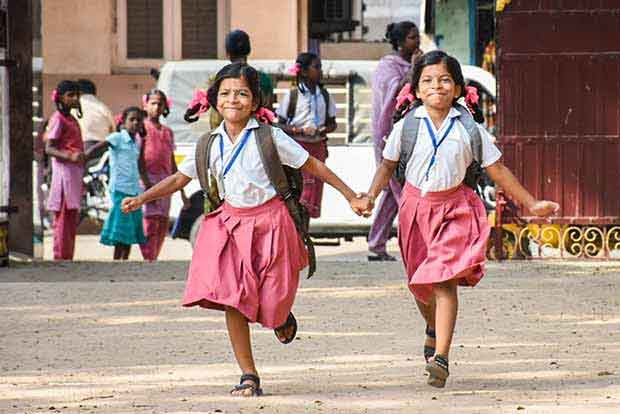
Come September, over 50 million children in the US will take their backpacks, wear fancy sneakers, dress up in branded outfits, carry a handy lunch bag and wait on the road as early as 7 am for the yellow colour bus to pick them up. For many from India, it will be hard to guess where these children are heading to.
Chennai
School? Can’t be. None of them is wearing the uniform, but are instead clad in bright coloured fashionable clothes. To expect uniform clad school kids in the US would prove you wrong. The schools here have no mandate for uniforms, which remains a puzzle for many immigrants from India. They repeatedly ask why it should be so.
In a country that is home to diverse cultures of the world, with people from vastly different ethnic background, wouldn’t uniforms in school help students feel less different? Interestingly, this has never been the case here. Saying no to uniforms is one of the ways a youngster maintains his or her individuality and self-expression, a promise backed by the First Amendment of the US Constitution. School is not a place to restrict the way you want to look or think, dress the way you like to express yourself. No one judges you by your looks, goes the Western belief.
So, when it is ‘back to school shopping’ that peaks in July every year, one starts with budgeting for not only T-shirts, shorts, and skirts, but accessories, backpacks, novelty socks andshoes among other items. Next to the holiday shopping, back-to-school shopping is probably the biggest shopping season in the US, which the retailers wait for.
But beyond this period, shopping dress for school is all year-round activity. When children enter middle school, their demand for branded outfits will rise. Jerseys to show their fan affiliation to a particular sports team will have to be honoured at a high cost. Blame it on the peer pressure for forcing the parents to shell extra dollars for filling the kids’ wardrobe.
“We are so used to wearing uniforms back in our days in India. I remember my school shopping was just in the beginning of the school year. We used to buy three to four pairs of skirts, shirts, socks and shoes for that whole year. Washing these and pressing them every weekend used to be compulsory chore. But now, for my children, we have to worry aboutchanging the wardrobe collection to suit the most recent fashion, which is a bigger challenge,” said Kameswari Srikanth, mother of two.
It is common to end up with overflowing closets with purchases to suit all the season for school kids. Clearing up the closet remains a major activity every passing season.
“Living in a state like New Jersey that has four distinct seasons, we end up buying clothes for our children once every three months. Children grow tall too fast, so what was bought for last fall will not fit the season this year,” said Sridhar Venkateswaran, a long-time resident of the state.
There are charity organisations that send home trucks to collect used clothes for recycle. Sparingly used clothes are donated during drives organised by schools and other non-profit institutions. They are also dropped at drop bins kept in public places.Apart from organised donations, piles of cloth are dumpedinto the landfill. In 2013, textile waste dumped in American landfills was 12.8 million tonnes.
Schools issue a broad guideline for the dress to be worn, but there are no prescribed uniforms at least in public schools. Private schools of course have their own designated uniforms but their numbers are limited. Of late, however, there has been a visible growth in the number of public schools opting for uniforms. In the last 15 years, about nine per cent increase is reported in the number of public schools that insist on wearing uniforms. According to the National Centre for Education Statistics, 21 per cent of public schools in 2015-2016 reported to have mandated uniforms, up from 12 per cent in 1999-2000. Much of it is in the schools located in cities and in communities with more low-income group residents.
The earliest experiment in prescribing uniforms for public school students happened in Baltimore in 1987. The origin of the uniform policy in Baltimore is linked to a 1986 shooting, in which a public-school student was wounded during a fight over a pair of $95 sunglasses. Many supporters of the uniform feel that it is easier to handle discipline issues. But to majority Americans, making uniform mandatory in schools is restrictive and hence never welcome.
For the Indian immigrants, sending their children to schools in fashionable outfits with loose hair and matching accessories is lot to comprehend. Many recall with nostalgia how one was allowed to wear non-uniform outfit to school on his or her birthday, which obviously attracted a lot of attention. Another unforgettable memory from those days back in India was the day after Deepavali where all children wear their new festival dress to school. Waiting for those special days when one could sport colour dress made all the difference in school back then!
— The writer is a journalist based in New York
Visit news.dtnext.in to explore our interactive epaper!
Download the DT Next app for more exciting features!
Click here for iOS
Click here for Android

Next Story