
- Chennai
- Tamil Nadu
- India
- World
- EntertainmentEntertainment
- Business
- Sports
- Lifestyle
- Technology
- Videos
- Explainers
- Editor's Picks

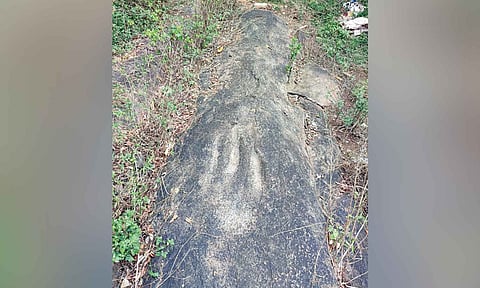
MADURAI: Rubbing grooves formed by the smoothing of Neolithic hand axes on rock have been discovered near Srivilliputhur in Virudhunagar district.
According to ‘Noorsakipuram’ S Sivakumar, the rubbing grooves on the rock are about 8,000 years old and are evidence of the Neolithic civilisation in southern Tamil Nadu.
The Tamil Nadu Archaeological Department has stated that the Neolithic Age dates from 7000 BC to 4000 BC, based on the scientific dating of archaeological sites in Tamil Nadu. It was during the Neolithic age that humans transitioned from a nomadic lifestyle to a settled one, and agriculture, pottery and permanent settlements emerged.
Speaking about the findings, V Rajaguru, the founder of the Ramanathapuram Archaeological Research Foundation, who conducted the exploration along with Sivakumar, said there are four rubbing grooves on the rock near the forest check post at Shenbagathoppu. These were formed when Neolithic hand axes were rubbed and smoothed. “Their dimensions are 40, 46, 48, 20 cm in length, 3.5, 3, 3, 1 cm in depth. All four are of the same size, 10 cm in width. Three grooves are straight and one is diagonal at the top,” he said.
The straight grooves would have been used to rub the stone tools smoothly, and the small diagonal groove would have been used to sharpen them, he noted, adding these are shallow compared to similar rubbing grooves found in northern Tamil Nadu. Rubbing grooves are mostly found near water bodies and there will be traces of stream.
The Archaeological Survey of India has found traces of Neolithic civilisation in southern Tamil Nadu at T Kallupatti. “We have found Neolithic tools at Viluppanur near Srivilliputhur, Bogalur and Kulapatham in Ramanathapuram district, and grinding pits used during the Neolithic period in the rocks under Gopalsamy hill in Madurai district,” he said.