
- Chennai
- Tamil Nadu
- India
- World
- EntertainmentEntertainment
- Business
- Sports
- Lifestyle
- Technology
- Videos
- Explainers
- Editor's Picks

CHENNAI: Tamil Nadu is witnessing a sharp surge in fever, typhoid and dengue cases, with health authorities reporting over 16,000 dengue infections and eight deaths till early October this year. The State Health Department has intensified door-to-door surveillance, awareness drives, and mosquito control operations across districts to contain the spread before the northeast monsoon sets in.
According to official data from the National Centre for Vector Borne Disease Control (NCVBDC), Tamil Nadu has recorded 16,546 dengue cases as of October 2025, the second-highest in the country after Karnataka. The State reported 27,378 cases and 13 deaths in 2024, compared to 9,121 cases and eight deaths in 2023, indicating a cyclical post-monsoon rise.
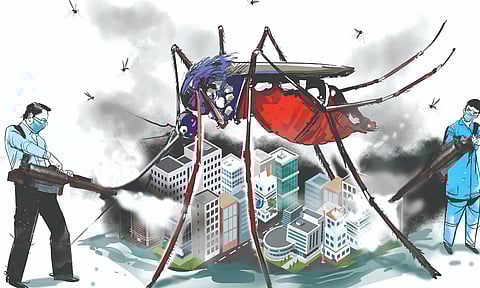
Officials attribute the spike to dynamic weather patterns, intermittent rainfall and water stagnation in residential areas, which create ideal breeding conditions for Aedes aegypti mosquitoes, the primary carrier of the dengue virus.
'Early detection could have saved us anxiety'
For Ganesh, a resident of Tiruvannamalai, the recent rise in fever cases hit home when his nine-year-old daughter fell ill last month.
“She developed a fever three weeks ago. We gave her medicines from a nearby pharmacy, but it didn't subside even after three days. A local clinic said it was viral fever, but she continued to suffer for nearly two weeks,” he told DT Next.
“Finally, on a relative's advice, we went to a private hospital in Chennai. After several tests, doctors confirmed it was typhoid, fortunately, in a recovery stage. They prescribed Zincovit and other medicines, and she is fine now. But if the illness had been identified earlier, we could have avoided the stress and discomfort,” he said.
Ganesh's experience mirrors that of several families across the State, as clinics and hospitals report a steady inflow of patients with persistent fevers and body pain symptoms.
Seasonal trend, but under control, says DPH Director
Dr A Somasundaram, Director of Public Health and Preventive Medicine, said the increase in fever and dengue cases between July and December is a seasonal pattern, not an outbreak.
“Every year during this period, cases of influenza, viral fever and dengue rise due to climatic changes. After December, the numbers will start declining,” he told DT Next.
“To track cases, we conduct fever surveillance in both government and private hospitals every day. Health inspectors and doctors are visiting homes and vulnerable areas to identify anyone showing fever or dengue symptoms and ensure they get prompt treatment,” he said.
He added that the department has stepped up vector control operations statewide. “We identify mosquito-breeding sites, ensure water doesn't stagnate, and spray larvicides in affected areas. High-risk zones are being monitored continuously, and awareness campaigns are being carried out across all districts,” he noted.
Dr Somasundaram stressed that public cooperation remains vital. “People should avoid staying bare-bodied during the day because dengue mosquitoes are day-biters that rest inside houses. Houses should be kept clean, and no water should stagnate behind refrigerators, in flower pots or containers. Use mosquito nets, especially for children, the elderly and pregnant women,” he advised.
“Those with fever should not self-medicate. Only paracetamol can be taken under medical supervision, and they must visit a doctor immediately. Our field teams are on continuous surveillance, and doctors in all government hospitals and PHCs have been trained to handle dengue cases effectively,” he added.
While the number of fever cases is increasing, the DPH Director assured that “the intensity is under control” and noted that “fatalities remain low”, with only eight deaths reported so far this year.