
- Chennai
- Tamil Nadu
- India
- World
- EntertainmentEntertainment
- Business
- Sports
- Lifestyle
- Technology
- Videos
- Explainers
- Editor's Picks

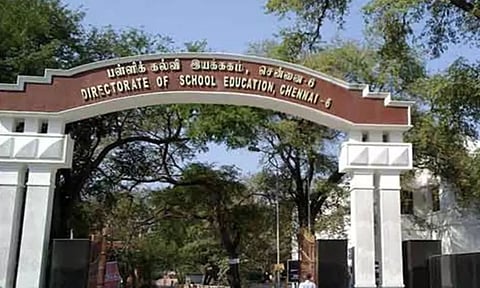
CHENNAI: Responding to a slew of criticisms concerning the State Education Policy (SEP) released by the Tamil Nadu government recently, the Department of School Education on Tuesday issued a rebuttal addressing various concerns raised by the stakeholders.
Chief Minister MK Stalin released SEP for school education, opposing the Centre's National Education Policy (NEP) 2020. The policy was formulated by the 13-member panel headed by the retired Delhi High Court chief justice D Murugesan.
Replying to the claim that SEP is violating the fundamental principles of policy formulation in the rebuttal, the education department clarified that the document is subject to periodic review.
“SEP allows dynamic incorporation of feedback from stakeholders at all levels. This ensures ongoing participation beyond initial drafting,” the document stated.
Further, reasoning why SEP is unique to TN, the education department stressed that it retains the two-language policy, instead of NEP’s three-language policy. Additionally, it resists the centralised entrance exams for undergraduate admissions, a concept which is distinct from that of TN.
Additionally, the response listed the innovations in SEP that include expansion of Ennum Ezhuthum mission with Grade-I readiness assessments, vocational curriculum updated with concepts of AI, robotics, agritech, and industry internships, and school digital infrastructure upgraded with online teacher resource portals in Tamil and English.
In response to the criticism of the ‘one-size fits all’ approach towards the policy, it highlighted that SEP speaks about strengthening the School Management Committees (SMCs) that will enhance local decision-making and community involvement.
On over‑centralisation via apps/platforms, the department pointed out that Education Management Information System (EMIS), TN‑SPARK, Palli Paarvai will not have a bearing on teacher autonomy but function as data management and transparency tools.
It further pointed out that teachers will be empowered through continuous professional development to design classroom processes suited to diverse learner needs.
Strongly rejecting the claims that SEP mirrors NEP, the statement added, “SEP explicitly rejects NEP's three-language policy, early centralised exams and CET for UG admissions. Also, SEP retains the 10+2 system and state curriculum control.”
The rebuttal emphasised that the NEP lacks public welfare and social justice, the core concepts based on which the TN government developed the SEP.
It further noted that SEP calls for education to return to the State list, in turn opposing privatisation, and community/CSR involvement is supplementary and not a substitute for state funding.
Meanwhile, L Jawahar Nesan, professor and former member of the SEP panel, urged CM Stalin to withdraw the document, stating that it merely highlights the existing works done by the government.
“Any policy should address vital curriculum, pedagogy, and future role of each scheme; however, SEP just lists existing schemes. SEP is not a policy at all,” Jawahar told DT Next.