
- Chennai
- Tamil Nadu
- India
- World
- EntertainmentEntertainment
- Business
- Sports
- Lifestyle
- Technology
- Videos
- Explainers
- Editor's Picks

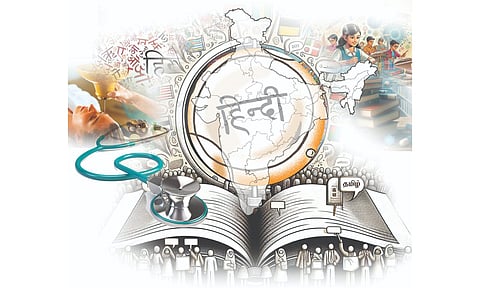
CHENNAI: It is a dangerous illusion to think that the Union grows stronger by enfeebling the States. In truth, they are the warp and weft of the same fabric: damage one, and the whole cloth unravels. Yet, decades of centralisation - justified in the name of national unity, uniform standards, or presumed State incapacity - have steadily eroded State autonomy, stifled innovation, dulled responsiveness, and weakened accountability. This is most evident in the core domains of Language, Education and Health, which fundamentally shape identity, culture, and daily life.
As C.N. Annadurai observed wryly in 1967, the Union requires no Departments of Education or Health to defend India’s sovereignty from Pakistan or China. Minimum national standards are legitimate; uniformity and Union micromanagement are not. A common floor strengthens diversity; a common straitjacket suffocates it. Our States, comparable in size and population to European nations, deserve trust and responsibility.
To deny them this is to imply that Indians are less capable of selfgovernment than Europeans - a calumny no patriot should tolerate.
Language
Language has been India’s most contentious federal question. In the Constituent Assembly, the pro-Hindi camp urged adoption of Hindi as the national voice, while leaders like Shyama Prasad Mukherjee and Frank Anthony argued for English. T. T. Krishnamachari spoke presciently against the perils of “language imperialism.”
The Constitution struck an uneasy compromise. States could adopt their own official languages, and linguistic minorities were granted safeguards. Article 343 declared Hindi the official language of the Union, while English was to continue as an associate official language for 15 years. But fierce anti-Hindi agitations in the 1960s forced Parliament to extend English indefinitely.
Article 346 permits English for Union–State and inter-State communication. Article 348 provides that the language of the higher judiciary and legislative drafting shall be English until Parliament decides otherwise. While the Constitution’s Eighth Schedule recognises 22 languages, Articles 344 and 351 privilege Hindi alone, an asymmetry that fuels resentment.
The “Foreign Language” Fallacy
Critics deride English as “foreign.” But so are potatoes, tomatoes, corn, cauliflower, pumpkin, capsicum, guava, papaya, pineapple, coffee and tea — none native to India, all introduced by the Portuguese, British, or Dutch, and all indispensable today. After over 250 years in India, English is no longer alien. It has evolved into a distinct Indian variety, was the language of the freedom struggle, and is the language of the Constitution itself.
Furthermore, “foreignness” is defined by linguistic distance - vocabulary, grammar and sounds - not modern borders. Hindi belongs to the IndoAryan family. For speakers of Tamil (Dravidian), Santali (Austro-Asiatic), or Mizo (Tibeto-Burman), Hindi is as “foreign” as English. To call Hindi “our own” and English “foreign” is a fallacy. Every language spoken by Indians, whether indigenous or naturalised, is equally Indian.
Unity or Domination?
Making Hindi the sole official language privileges some States and alienates others. English is neutral: it belongs to no region, carries no hegemonic stamp, is the world’s de facto lingua franca, and is indispensable for higher education, science, technology, business, and diplomacy. Hindi cannot fulfil these roles. History offers a parallel: Ireland tried to elevate Gaelic alongside English, but modern life left English dominant.
The belief that national unity requires one national language is refuted by global experience. Switzerland thrives with 4 official languages - French, German, Italian, and Romansh. In Canada, English and French share equal status. The European Union (E.U) has 24 official languages. Singapore - 74% Chinese - avoided imposing Mandarin. By adopting English as a neutral lingua franca while nurturing Malay, Tamil, and Mandarin, Singapore secured social cohesion and global competitiveness. Conversely, coercion has proven catastrophic: Pakistan’s imposition of Urdu fractured the nation, creating Bangladesh in 1971, and imposition of Russian hastened the Soviet Union’s collapse.
The Illusion of Hindi Dominance
Census 2011 claims that 44% of Indians speak Hindi, but as G. N. Devy shows in “India: A Linguistic Civilization”, this figure is inflated by classifying 53 independent languages as “dialects” of Hindi. Languages like Bhojpuri, Rajasthani, Magadhi, Chhattisgarhi, Haryanvi, and Bundeli are centuries older than Hindi, while some, like Banjari, are mutually unintelligible. True Hindi speakers are closer to 25%.
The same Census reveals that 63% of Indians never leave their birthplace, 85% remain within their district, and 95% never migrate beyond their State. With migration largely away from the Hindi belt, imposing Hindi as lingua franca is deeply misguided.
The Failed Three-Language Formula
National Education Policy (NEP) 2020’s compulsory three-language formula is a backdoor push for Hindi. Though in place since 1968 (except Tamil Nadu), Census 2011 shows only 7% of Indians are trilingual - less than 2% in the Hindi belt. Surveys reveal that many students struggle even with their first language and barely manage English. Should we not teach two languages well rather than three poorly? The government never tests thirdlanguage proficiency, masking the policy’s failure.
Research affirms bilingualism’s cognitive benefits but finds diminishing returns beyond two languages. NEP 2020 ignores this evidence, the chronic shortage of teachers and resources, and the rise of AI translation tools, rendering the three-language mandate both impractical and obsolete.
Roadmap for Linguistic Federalism
The following reforms are imperative:
1. Correct Census Distortions: Stop misclassifying 53 independent languages as “dialects” of Hindi, and show the true number of Hindi speakers.
2. Expand the Eighth Schedule: Automatically include all languages with over 10 lakh speakers (33 in total, including English) to the Eighth Schedule, raising the tally to 55.
3. Amend Article 343: Make English a permanent official language of the Union. Also, recognise all Eighth Schedule languages as official languages of the Union – in line with the E.U model.
4. Amend Article 348: Entrench English in the higher judiciary and legislative drafting.
5. Amend Article 346: Secure English permanently as the Union–State and inter-State link language.
6. Delete Article 344 and amend Article 351 to promote all Eighth Schedule languages equally, not just Hindi.
7. Scrap the three-language formula: Focus on bilingual proficiency English for employment opportunities, regional languages for cultural preservation - and let AI-powered tools handle additional languages.
True unity is forged when every Indian feels that his language is cherished as part of our common inheritance. The cement of integration is consent, not compulsion; respect, not domination; harmony, not homogenisation.
Education
The most compelling argument for State autonomy is subsidiarity - the doctrine that decisions should be made at the lowest level of governance capable of effectively addressing the issue at hand. In education, this means States should operate schools, colleges, and universities, while the Union focuses solely on national institutions, advanced research, and setting broad standards.
In all mature federations - the USA, Canada, Australia, Germany - the federal government does not run educational institutions. It funds initiatives, sets standards, and supports research, but the lifeblood of education flows through the States. Only in India has the Union appropriated the bloodstream itself. But this was not always so.
A misstep:
At its inception in 1950, the Constitution placed Education squarely within State jurisdiction (State List, Entry 11), recognising its organic ties to language, culture, and local realities. The Union’s role was narrow: to manage institutions of national importance and coordinate minimum standards (Union List, Entries 63–66).
This balance collapsed when the 42nd Amendment (1976) shifted Education to Entry 25 of the Concurrent List, granting Parliament overriding authority. The Supreme Court further eroded State power by expansively interpreting Entry 66 of Union List - meant only for “coordination and determination of standards” – as licence for the Union to control admissions, dictate curricula, and regulate university governance, even though “regulation of universities” still vests with States (State List, Entry 32).
Centralisation has not fostered excellence
Over-centralisation and rigid regulation by bodies such as the UGC and AICTE have reduced State universities to glorified affiliated colleges, while providing scant funding. No nation ever regulated itself into academic excellence. In the Times Higher Education 2025 global rankings, no Indian university figured in the top 200; even IISc, Bangalore was in the 201–250 bracket while JNU, Delhi fell between 801-1000. By contrast, the USA had 55 universities in the top 200, Germany 20, Australia 10, and Canada 8.
Due to the Union duplicating State functions, India starves research, spending just 0.65% of GDP on R&D against 3.5% in the USA, 3.1% in Germany, 1.8% in Australia, and 1.6% in Canada.
At the school level, India’s only Programme for International Student Assessment (PISA) outing in 2009 placed it 73rd of 74 countries, ahead only of Kyrgyzstan. Since then, India has quietly withdrawn from every PISA cycle, including 2025.
Tyranny of National Entrance Tests
The most visible outcome of the centralisation impulse is the proliferation of national entrance tests. Beginning with the National Eligibility-cum Entrance Test (NEET) for medical admissions, the Union now seeks to impose all-India, high-stakes, multiple-choice entrance tests across disciplines. This makes secondary schooling irrelevant, fuels coaching factories and dummy schools, worsens student stress and mental health, and deepens inequities by forcing rural and State-board students into tests tailored to an urban, English-medium elite.
Misuse of Union Subordinate Legislation
Article 254(1) allows only plenary Union laws to override plenary State laws in the Concurrent List. Yet, the Union and its agencies claim their rules and regulations supersede State laws - a power even Parliament cannot wield without due process. For example, UGC asserts its regulations supersede State University Acts, paralysing governance. In Tamil Nadu, 11 of 20 Vice-Chancellor posts remain vacant due to this conflict. Two Constitution Benches of the Supreme Court (1961, 1975) held unequivocally that subordinate legislation remains subordinate and does not merge with the parent Act merely because it is laid before the Legislature. Hence, UGC Regulations neither merge with the UGC Act, 1956, nor override State University Acts. Under Section 12(d) of the Act, UGC’s powers are only recommendatory. Yet, conflicting two-judge Bench rulings - some upholding UGC primacy, others supporting States - have deepened the confusion. Only a definitive Constitution Bench ruling can resolve this crisis.
Governor as Chancellor
Equally problematic is the Governor’s role as ex-officio Chancellor of State universities - a colonial relic designed for imperial oversight. After Independence, the practice continued. Until 1967, with one-party dominance at the Union and State levels, it was largely ceremonial. But once political divergence emerged, most Governors being career politicians, the role turned contentious. Article 163 binds Governors to ministerial advice in their constitutional role, but as Chancellors under university statutes they act autonomously. This has allowed them to bypass elected governments in appointing Vice-Chancellors and other university matters, especially in Opposition-ruled States. The flaws are glaring: power without accountability, no academic expertise, opaque decision-making, and universities reduced to political battlegrounds. The solution: Governors should not head State universities. Chancellors must be apolitical, eminent figures appointed by State governments. But Governors stall such reforms by withholding assent to the amendment Bills or referring them to the President.
Roadmap for Education Federalism
The following reforms are imperative:
1. Restore Balance: Return Education to the State List; confine Entry 66 to minimum standards.
2. Adopt global best practice: Let the Union focus on advanced research, national institutions, and standards, while States run schools, colleges, and universities with full control over admissions and curricula.
3. Affirm constitutional discipline: Only plenary Union laws - not subordinate legislation – may override plenary State laws in the Concurrent List.
4. Divest Governors of their statutory role as Chancellors of State Universities.
Education thrives on freedom, not regimentation; on diversity, not uniformity. No fiat from Delhi can create excellence; it is born when States are trusted to innovate.
Health
At its inception in 1950, the Constitution wisely placed both public health (State List, Entry 6) and medical education (State List, Entry 11) under State jurisdiction. The framers understood that India’s immense diversity of disease burdens, languages, and cultures required local solutions. States were thus empowered to tailor curricula, admissions, and health campaigns suited to their populations. The Union’s role was confined to institutions of national importance and coordination of minimum standards (Union List, Entries 63–66).
This balance was overturned by the 42nd Amendment (1976), which shifted Education, including medical education, to the Concurrent List (Entry 25). Expansive judicial readings of Entry 66 enabled the Union to dictate curricula, admissions, and recognition of institutions. The result is a dangerous policy-implementation gap: States deliver healthcare, but the Union alone controls medical education.
The Silencing of Federal Voices
Whatever its faults, the Medical Council of India was a genuinely federal body. Elected representatives from State Medical Councils and universities shared power with Union nominees in shaping medical education. The National Medical Commission (NMC) Act, 2019 dismantled this arrangement. The new Commission is dominated by Union appointees; the States are invited only as spectators in an advisory role.
The NMC Act prescribes NEET for admissions, and National Exit Test (NExT) for licensing doctors. NEET fails the meritocracy test. The five-year average cut-off for general candidates for NEET-MBBS hovers around 20%. The cutoff for NEET-Postgraduate was 0% in 2023 and 5% in 2024, and for NEETSuper Specialities was 0% in both 2023 and 2024. These abysmal thresholds exist only to let private colleges fill exorbitantly priced seats, while poorer students face fierce competition for scarce government seats with very high cut-offs. Earlier State models, based on Class XII marks and reservations, produced doctors rooted in local service. NExT, if introduced, will delegitimise university medical degrees, prioritise test-taking over clinical skills, and undermine true excellence.
When Integration Becomes Appropriation
The All-India Quota (AIQ), conceived to foster integration, has become an instrument of judicially sanctioned over-centralisation. In Pradeep Jain
(1984), the Supreme Court mandated 15% AIQ in MBBS seats in State medical colleges. This was expanded in Dr. Dinesh Singh Chauhan (2017) to 50% of postgraduate seats, and in Tamil Nadu Medical Officers Association (2020) to 100% of super-speciality seats. This penalises States that invested in medical infrastructure, rewards those that did not, and deprives States of local-language doctors - weakening rural and primary healthcare. It also disincentivises States from creating new institutions/departments, knowing local students gain little.
A partial correction came in N. Karthikeyan (2022), which allowed Tamil Nadu to reserve 50% of its super-speciality seats for in-service doctors. A fair recalibration is overdue: AIQ must be capped at 15% across all levels.
Dilution of State Health Models
Though public health is a State subject, the Union dictates policy through financial coercion. The National Health Mission (NHM), conceived as a partnership, now functions as a command-and-control mechanism. Funds are tied to Union templates; parallel “State Health Societies” bypass State Health Departments; and Union branding overshadows State contributions.
Tamil Nadu’s internationally admired Primary Health Centre network, Kerala’s palliative care system, and Maharashtra’s mental health initiatives are weakened by one-size-fits-all Union diktats. Doctors and nurses spend more time filling Union forms than treating patients, while the Ayushman Bharat Digital Mission threatens data sovereignty by centralising sensitive health records.
Cultural and Ideological Centralisation
National health campaigns, drafted in Hindi and English with North Indian motifs, are often mistranslated, leaving citizens of non-Hindi States cold.
The Union’s AYUSH policy lavishes resources on Ayurveda and Yoga while marginalising Siddha.
Global Lessons
Unlike India, in all mature federations such as the USA, Canada, Germany, and Australia, States and universities control medical admissions and curricula. The federal role is confined to setting broad standards, accreditation, and funding. There is no mandatory federal entrance exam.
Public health delivery follows the same pattern. Canada’s federal government sets five broad principles, but provinces run health systems. In Australia, federal and State governments share costs, yet hospitals remain State-run. Germany co-governs health through Centre–Länder bodies. The USA gives States wide latitude in regulating health, pharmacies, and insurance.
Roadmap for Health Federalism
The following reforms are imperative:
1. Restore Balance: Return medical education to the State List; limit Entry 66 to minimum standards.
2. Federalise Institutions: Reconstitute the NMC with 75% State representation; mandate State voices in all Union health regulators.
3. Recalibrate AIQ: Enact a Union law capping it at 15% across all levels, safeguarding in-service quotas.
4. Fiscal Autonomy: Replace tied Union scheme grants with untied block grants to States.
5. Roll back Union encroachment in all its forms in public health delivery, a State subject.
6. Cultural Sensitivity: Ensure health campaigns in State languages; fund Siddha and other regional systems equitably.
India’s public health system will remain infirm so long as the States are saddled with responsibility but stripped of authority. The remedy lies not in more schemes from Delhi, but in restoring the federal balance.
Concluding Remarks
A strong Union and strong States are not antagonists but partners; each draws vitality from the other. India’s prosperity rests on embracing the principle of subsidiarity - the Union confining itself to essential, pan-Indian functions that it alone can perform well, while States enjoy complete autonomy over matters closest to their people. The Union must renounce the compulsive urge to control and micromanage.
Thiru K. Santhanam, member of the Constituent Assembly, foresaw this clearly: “A strong Centre is indispensable if India is not to disintegrate. But I do not agree with those who equate strength with the range of formal constitutional powers. By taking upon itself too many obligations in relation to the vast population spread over the length and breadth of India, the Centre will become incurably weak. It is only by concentrating on essential all-India matters, while giving complete autonomy to the States in the rest, that the Parliament and the Central Government can be really strong.” His counsel comes to us with the weight of history and the warning of experience - it has never been more urgent or necessary.