
- Chennai
- Tamil Nadu
- India
- World
- EntertainmentEntertainment
- Business
- Sports
- Lifestyle
- Technology
- Videos
- Explainers
- Editor's Picks

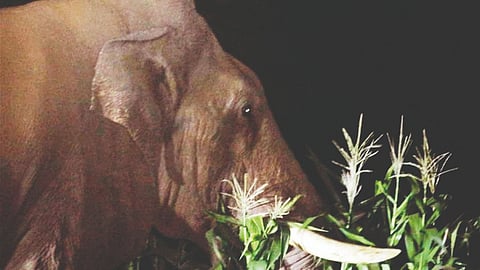
COIMBATORE: For farmers living along the forest fringes of Mettupalayam, the arrival of the famed wild tusker Bahubali may be a familiar sight, but it often comes with a high financial cost.
Overnight crop raids by the elephant are leaving cultivators struggling to recover their losses, with many demanding higher compensation and a permanent solution to human-elephant conflict.
Farmers say they have learned to coexist with Bahubali and do not consider the elephant a direct threat to human lives. However, its repeated raids on agricultural fields are affecting their livelihoods, particularly those dependent on banana cultivation.
“The Forest Department provides compensation of around Rs 100 for each plantain plant damaged by an elephant. But during the Onam season, a kilogram of the ‘Kathali’ variety of banana fetches around Rs 80, and a single stem weighing nearly 10 kg can bring in about Rs 800. The compensation amount is far too low and should be increased,” said N. Subbaiyan, president of the Tamil Nadu Vivasayigal Sangam, Mettupalayam taluk.
Farmers also complained that compensation payments are often delayed and involve a lengthy process. They said identifying the elephant responsible for crop damage is difficult, as most raids occur during the night.
“In one incident, an elephant damaged nearly 60 plantain plants in our farm within three months. We did not even apply for compensation because we were not confident of receiving a fair amount after going through the process,” Subbaiyan said.
He added that despite repeated demands from farmers, the compensation amount has remained unchanged for more than a decade. The uncertainty has forced several cultivators to reconsider banana farming. “Like many other farmers, we are gradually shifting from plantain cultivation to arecanut, as it is less vulnerable to elephant attacks,” said Subbaiyan, who owns farmland in Mettupalayam.
T Venugopal, president of the Tamilaga Vivasayigal Sangam, said farmers were looking beyond financial compensation and wanted a long-term solution to recurring elephant intrusions.
“Compensation alone cannot address the problem. Several measures taken by the government so far have not produced the desired results, and the compensation amount has also been reduced in recent times. Farmers have lost confidence that the elephant intrusion issue can be resolved,” he said.
According to farmers, growing uncertainty over crop losses has pushed some cultivators to sell their lands to real estate developers rather than continue farming along the forest boundary.