
- Chennai
- Tamil Nadu
- India
- World
- EntertainmentEntertainment
- Business
- Sports
- Lifestyle
- Technology
- Videos
- Explainers
- Editor's Picks

COIMBATORE: For nearly twenty years, the sight of a massive wild elephant emerging from the forests of Mettupalayam at dusk has become more of a daily spectacle.
Fondly called ‘Bahubali’ by people and identified by the Forest Department as MP 20T1, the tusker’s predictable habits and calm nature have helped it build an unusual relationship with villagers.
"Villagers have become so familiar with the elephant that they no longer panic when they see it. It rarely displays aggression unless provoked and does not charge at people without reason. The elephant has made Mettupalayam and Sirumugai as its home range in all these years," Forest Department officials said.
As the sun sets, Bahubali emerges from the forest and heads towards nearby farmlands in search of food. It remains there through the night, moving between fields and returning to the forest only in the early hours after satisfying its hunger.
Even when farmers or forest personnel attempt to drive it away, the elephant often retreats briefly before returning to another farm nearby. Its persistence has made it a familiar visitor to plantations growing bananas, sugarcane, coconuts, mangoes, and jackfruits.
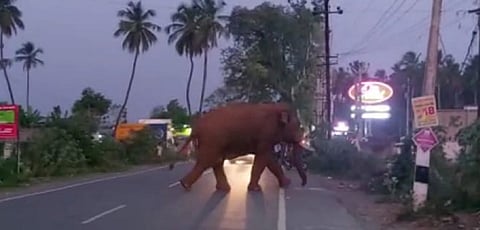
The tusker’s movements have become so predictable that Forest Department personnel regularly manage traffic on the Mettupalayam-Ooty Road to allow it to cross safely. In a curious display of caution, Bahubali often waits until vehicles are stopped before calmly making its way across the busy road.
"Over the last 15 years, I have seen the elephant cross the road many times. It always waits for the vehicles to stop and has never harmed anyone," said P Sarath Kumar, an anti-poaching watcher with the Mettupalayam Forest Range.
To ensure the safety of both the elephant and road users, the Forest Department has assigned a dedicated squad comprising a forest guard, a watcher, and an anti-poaching watcher to monitor Bahubali’s movements during its regular morning and evening crossings.
The elephant’s familiarity with the landscape is matched by its remarkable memory. Officials say it knows exactly where to find its preferred food sources, returning repeatedly to farms and orchards that offer seasonal favourites.
"Mango and jackfruit are its first choices. Once that season ends, it shifts towards maize and plantain fields," a Forest Department official said.
In recent days, the tusker has shifted its base to the neighbouring Sirumugai Forest Range, attracted by the availability of plantain crops after the mango and jackfruit season ended in Mettupalayam orchards. Officials expect it to remain there for a few months before returning to its familiar Mettupalayam range.
Unlike many elephants that travel in groups, Bahubali prefers a solitary existence. Officials believe this unusual behaviour developed after earlier attempts to prevent other elephants accompanying it from becoming habitual crop raiders.
In the past, when other elephants migrated along with Bahubali, the Forest Department made considerable efforts to drive them away to prevent them from following the same crop-raiding pattern. Over time, officials observed that Bahubali appeared to associate the presence of other elephants with difficulty in its search for food and began avoiding companions.
“On several occasions, it has even chased away elephants attempting to join it,” said P Sarath Kumar.
While wild elephants typically travel more than 40 kilometres daily in search of food and water, Bahubali has confined its movements to a smaller area of around 20 kilometres, relying on its intimate knowledge of local farms and forest corridors.
“The tusker has entered Mettupalayam more than 900 times in the past six years. Of this, more than 430 intrusions were made in the last three years alone,” said another official of the forest department.
The elephant has also proved difficult for the Forest Department to monitor through conventional methods. Multiple attempts to radio-collar and capture it have failed, as the tusker quickly senses unfamiliar activity and retreats deep into the forest. "If Bahubali notices veterinarians or unfamiliar people approaching, it disappears into the forest and remains away for several days before returning," the official added.
Instead of reacting with fear, farmers nowadays keep watch over their fields and immediately alert the Forest Department when the elephant arrives.