
- Chennai
- Tamil Nadu
- India
- World
- EntertainmentEntertainment
- Business
- Sports
- Lifestyle
- Technology
- Videos
- Explainers
- Editor's Picks

CHENNAI: Tamil food is often represented by a familiar list of dishes like Chettinad food, Madurai bun parotta, dosa, idli, Ambur and Dindigul biryani.
But Chef Goku says there is much more to Tamil food than these familiar dishes.
His new project with Nirupama Reddy, Tamil Quarter, explores the lesser-known food traditions of Tamil Nadu and Tamil communities across the world.
“I have been working on this project for the last two years, documenting recipes from different regions and communities. There are so many food traditions within Tamil Nadu that are not usually represented. We wanted to bring those dishes back and showcase the different varieties of Tamil food,” says Goku.
Tamil Quarter, a food revival project and dining experience, is an initiative of Pushpa’s Kitchen.
The project looks at food through the regions, communities and people behind it, working with farmers, fisherfolk, pastoral communities, indigenous communities, home cooks, artisans and small producers.
“We wanted to document these recipes and understand the communities and people behind them. A lot of these recipes are passed down through generations, but they are not documented,” he says.
The project also looks beyond Tamil Nadu, tracing how Tamil food has travelled through migration and evolved in countries such as Malaysia, Singapore, Sri Lanka, Trinidad and Tobago, Pakistan and Myanmar.
“Tamils have been living in these places for generations and their food has evolved according to the ingredients available there. But the core of the food is still Tamil,” points out Goku.
Tamil Quarter will function as a dining experience, with a new chapter every three months.
The experience will take place three of four consecutive days every month, with each chapter focusing on a particular region, community or food tradition.
The first chapter, running from September to November 2026, focuses on the Gulf of Mannar, covering the coastal stretch from Thoothukudi to Rameswaram, including Kayalpattinam, Mandapam and Ramanathapuram.
The food traditions of the region have been shaped by the sea, fishing communities, local ingredients and migration, including the influence of Sri Lankan refugees who travelled along this coast.
“For the first three months, we are focusing on the Gulf of Mannar region, stretching from Thoothukudi to Rameswaram and covering Kayalpattinam, Mandapam and Ramanathapuram. It is a coastal stretch and there is also a lot of Sri Lankan influence because refugees came through this route by boat. Those are some of the stories we are telling,” he says.
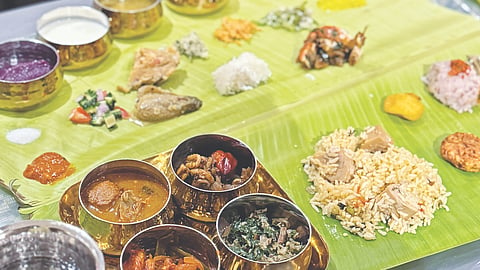
The Gulf of Mannar menu will feature 12 courses, largely following traditional methods. Goku says every detail has been researched and documented, while a few dishes have been given a contemporary interpretation.
“Usually, Tamils put a sweet on the elai, and the meal starts with a sweet and ends with a sweet. One of the most unique things from the Gulf of Mannar is a kathrikkai dessert, which we are showcasing,” he says.
Another dish is Mudalur muscoth halwa, a sweet with Sri Lankan influence that became part of Thoothukudi’s food culture.
The menu will also feature ingredients and preparations such as koolichor with sea urchin roe thuvayal, seaweed keerai kootu, bringing lesser-known coastal food traditions to the table. “I wanted people to taste and see these foods. There are so many lesser-known ingredients and preparations from different regions of Tamil Nadu and we want to bring them into the dining experience,” says Goku.
The second chapter, from December 2026 to February 2027, will move to Kumbakonam and the surrounding Cauvery delta, focusing on agraharam and temple food traditions.
The dining experience will explore vegetarian food, temple offerings, festive preparations and lesser-known dishes from Tamil Brahmin households.
“The Kumbakonam food pop-up is also during Margazhi season, so we wanted to showcase vegetarian food and temple food, including lesser-known preparations that are not usually presented,” he adds.
The third chapter, from March to May 2027, will travel to Penang, Malaysia, to explore the food of the Tamil diaspora.
Goku has already researched the region and plans to return for further research. “For Penang, I have done a lot of research and I will be going there again. The idea is to understand how Tamil food has evolved there while still retaining its core,” he says.
For Goku, Tamil Quarter is not just about recreating forgotten dishes. It is also about documenting the people, ingredients and stories connected to them.
“It is a passion project for Nirupama ma’am and me. We want to tell these stories through food and make people curious about the different food traditions within Tamil culture,” he says.
Tamil Quarter will officially launch on September 27 at Hanu Reddy Residences, Poes Garden. For more on the project, check out @tamil.quarter, @chefgokuny and @pushpaskitchenofficial on Instagram.