
- Chennai
- Tamil Nadu
- India
- World
- EntertainmentEntertainment
- Business
- Sports
- Lifestyle
- Technology
- Videos
- Explainers
- Editor's Picks

CHENNAI: Helping homemakers meet grocery needs, mobile recharges, and all the way to buying those small grams of gold hugely cherished by any family in the State, the DMK regime's one of the flagship schemes, Kalaignar Magalir Urimai Thittam (KMUT), has extended its run with the launch of the second phase, adding beneficiaries left out earlier.
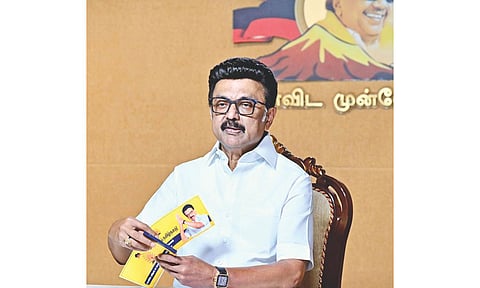
The State government organised an event titled 'Vellum Tamil Pengal' on Friday to announce the launch of the 2nd phase and celebrate the success of KMUT and other flagship schemes of the DMK government.
The KMUT is extending its wings at a time when the scheme has made a significant mark not just across the State but the entire nation. The case study of how a state like Bihar, ruled by an alliance government having as a constituent the BJP, which is at odds with the Dravidian major, is a key proof of the irrefutable impact of the scheme empowering women heads of the family.
Even while ridiculing DMK's claims of Dravidian model governance, many parties are copying their scheme, especially in states heading for polls, amidst trickling feedback from beneficiaries, which points out the crucial role of Rs 1,000 per month 'rights amount' (urimai thogai, not dole out) to women has on the well-being of the families.
Tamil Nadu's familiar welfare architecture has had feathers in its crown with the KMUT, if we go by the feedback from beneficiaries.
Vasuki, a domestic worker from Chennai, calls it her "reserve fund." Her wages, she says, arrive irregularly, but the one thing that she can count on is the bank message notifying her of the Rs 1,000 credited online. "I keep it for what I can't cover with my own earnings," she says, pointing to vegetables and her mobile recharge expenses. "Recharge costs keep getting higher. I keep the KMUT amount for those purposes as it greatly helps my son's studies too."
Chennai-based tailor, 28-year-old Jayanthi, a major breadwinner who has to take care of her younger sibling studying in college, puts it differently. It's the only amount that helps her walk straight, she points out to her new pair of footwear. "All of my salary goes into the household expenses. This is the amount I use to buy for my essential needs, such as footwear," she said. If not for KMUT money, she would be forced to postpone such expenses towards her own needs.
Across interviews, whether in urban or rural areas, beneficiaries share similar stories of how the money offers a small zone of discretion, which has been otherwise missing for these homemakers all these years. Many women acknowledge that the amount also goes into family needs, but what they emphasise more is the personal autonomy it creates.
In Thamaraikkarai, a hilltop village in the Bargur hills of Erode district, 30-year-old Kayalvizhi has been the sacrificer of sorts when it comes to her own expenses. Her family's income shrank after grazing restrictions cut off their primary livelihood. Agricultural labour now supports the three of them. "When I don't find funds for expenses, KMUT is what comes to the rescue," she says.
In Punnapakkam, Ikkadu post, Tiruvallur district, 25-year-old Saritha, mother of two boys aged four and two, says the amount has helped her manage recurring medical expenses. "Children fall sick often. Without this money, I would be torn between many other essential needs, which compete with my sons' health care," she says. What remains after medicine expenses is quietly saved for LPG refills or, once in a while, a tiny gold purchase, she adds. "The aid (KMUT) is steady," she adds, pointing out how dependable the scheme is for people living on the fringes.
For 55-year-old Mariya in the same village, the meaning is simpler. Rs 1,000 is my freedom. I don't have to stand in front of my husband or son for hospital money," she says.
Launched in 2023, the scheme now covers about 1.13 crore beneficiaries. The State Planning Commission has found the mammoth reach of the scheme, identified disparities in target groups' access to it, and set a roadmap to fix the gaps, including inclusion errors, documentation delays, lower urban awareness, and Aadhaar linking issues.
As the scheme enters its next phase ahead of a crucial election year, what ultimately counts is not the political brownie points one party or regime is set to gain, but how the scheme is transforming lives across the State. As one beneficiary, Kayalvizhi, succinctly puts it, "The Rs 1,000 counts more than it can be spent."