
- Chennai
- Tamil Nadu
- India
- World
- EntertainmentEntertainment
- Business
- Sports
- Lifestyle
- Technology
- Videos
- Explainers
- Editor's Picks

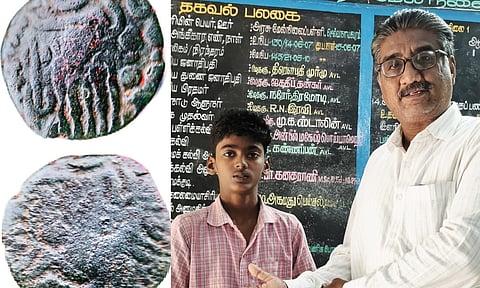
MADURAI: B Prasith Balan, an SSLC student of the Government Higher Secondary School, in Selvanayagapuram, near Mudukulathur in Ramanathapuram district, found a 1000-year-old Eelam coin bearing the name of Rajaraja Chola-I.
At a time when the boy was walking on the school playground before attending a special class at Selvanayagapuram, he spotted the coin bearing the name of Rajaraja Chola-I (985-1012 AD) and informed the school headmaster, M Ahmed Faisal.
Based on the information presented by the school administration, V Rajaguru, the founder of the Ramanathapuram Archaeological Research Foundation, examined the coin.
Coins played a vital role in the study of history and culture. Eelam coins were issued as a special release in the context of Rajaraja Chola-I's conquest of Sri Lanka. These coins were in use during the period from Rajaraja Chola-I to the time of Kulothunga Chola-I. These coins were issued in gold, silver and copper. Although minted for use in Sri Lanka, they were also in circulation in the territories under Chola rule, Rajaguru said on Tuesday.
On one side of the coin, a man stands holding a flower in his hand, with four circles to his left. Above them is the crescent, and below is a flower. To the right are a trident and a lamp. On the other side, a man is seated, holding a conch in his hand and near their left hand, the words ‘Sri Raja Raja’ are inscribed in three lines in Devanagari script. The inscriptions are not clear due to verdigris on the coin. The edges are worn.
While Eelam coins were found in several coastal villages such as Periyapattinam, Thondi, Kalimankundu, Alagankulam, Koraikuttam, and Tiruppullani in Ramanathapuram district, their discovery in an inland area is of historical significance. Years ago, students from the GHSS in Tiruppullani found Eelam coins at several coastal hamlets, he said. The school HM Faisal and the teachers congratulated the student.
According to C Santhalingam, a Madurai-based retired archaeologist and founder of Pandya Nadu Centre for Historical Research, the Eelam coins date back to the 10th and 11th centuries.
Recalling his days, he said he was fortunate to have collected an Eelam gold coin of Rajendra Chola at Neeravi village in Kamuthi taluk of Ramanathapuram in 1987.
In ancient days, Chola emperors, including Rajaraja Chola and Rajendra Chola, who conquered Sri Lanka, issued coins of gold, silver and copper for their use in the Island nation, which also witnessed their rise to maritime power as the era of the Southeast Asia trade.
In the old days, they frequented Rameswaram, a coastal Island and established trade links that necessitated the increase of Eelam coins. It’s mostly known as the Eelam black coin (Eelam karunkasu). Ancient trade relations between Sri Lanka, which was formerly known as ‘Ceylon’, and Tamil Nadu’s coastal town of Ramanathapuram also blossomed into marital relations.
Many people from Sri Lanka, in those days, used to travel by boats to Rameswaram and enjoyed their time watching stage plays, including ‘Valli Thirumanam’ at night and returning to their hometown, he said.