

DT Explains: How do cyclones brew in the sea? And why is the next one named Montha?
The name Montha, suggested by Thailand, means 'fragrant flower' or 'beautiful flower' in the Thai language.
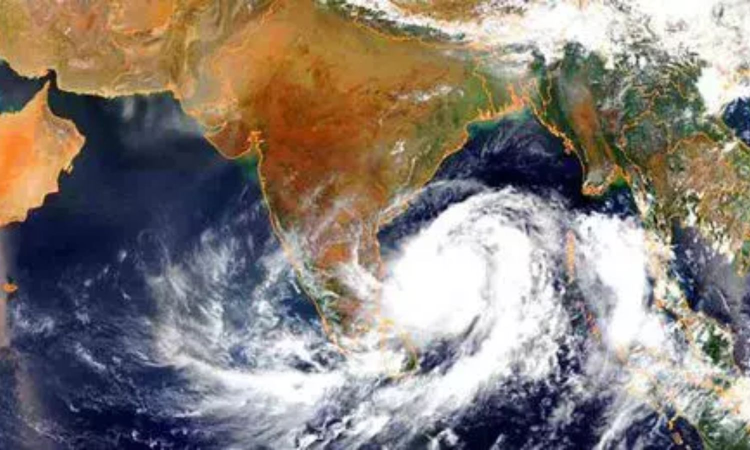
Representative Image (Cyclone)
The India Meteorological Department (IMD) said that the well-marked low-pressure area over the southeast Bay of Bengal has intensified into a depression on Saturday (October 25) morning, and is expected to develop into a cyclonic storm named Montha by Monday (October 27). The name Montha, suggested by Thailand, means 'fragrant flower' or 'beautiful flower' in the Thai language.
Curious how the name came about, and how countries get to name them?
This is how: Cyclones that are formed in the North Indian Ocean (Arabian Sea and Bay of Bengal) have been given names by the World Meteorological Organisation (WMO) since 2004. The organisation has formed a panel in which Bangladesh, India, Iran, Maldives, Myanmar, Oman, Pakistan, Qatar, Saudi Arabia, Sri Lanka, Thailand, United Arab Emirates, and Yemen are member states, countries that could be affected by the cyclone.
All the panel members would suggest four names each and these names would be tabled. Once low-pressure areas in the Arabian Sea or Bay of Bengal intensify and become cyclones, they will be christened sequentially using the tabled names. The names will not be repeated; that is, once used, the name will not be used again. The next cyclone, which is predicted to form in the Bay of Bengal in a few days, will be named Montha, a name suggested by Thailand. For the subsequent cyclones in the North Indian Ocean, the names would be Senyar (UAE), Ditwah (Yemen), and so on will be given in that order. Once all the tabled names are used, the member countries will propose new lists.
What is a low-pressure area and cyclone?
Low-pressure area forms over a sea when the air pressure in the particular region becomes lower. This causes winds from nearby regions to converge and rotate. In the Northern Hemisphere, the low pressure would rotate anti-clockwise and in the Southern Hemisphere, it would rotate clockwise.
The North Indian Ocean is in the Northern Hemisphere. When the low-pressure area intensifies in size and speed, it will become a depression and then turn into a cyclone. When the cyclone closes in on coasts, the sea level rises and causes storm surges. Interestingly, cyclones, hurricanes, and typhoons are the same weather phenomenon, the only difference being the location where the system forms.
For low pressures formed in the North Atlantic and Northeast Pacific, the term hurricane is used, while it is typhoon if the low pressure is formed in the Northwest Pacific Ocean. The term cyclone is used for the low-pressure system formed in the South Pacific and Indian Oceans.