
- Chennai
- Tamil Nadu
- India
- World
- EntertainmentEntertainment
- Business
- Sports
- Lifestyle
- Technology
- Videos
- Explainers
- Editor's Picks

CHENNAI: TVK's victories in Madurantakam and Dharapuram have preserved the ruling party's electoral momentum, but the hard-fought contests have exposed the limits of Chief Minister C Joseph Vijay's personal appeal and the organisational challenges confronting his fledgling government.
The bypolls presented a different test from the April Assembly elections, when TVK, contesting independently, won 108 of the 234 seats with 34.92 per cent of the vote. Five months into government, the party entered the fray with the advantages of incumbency, support from allies including the Congress, VCK, MDMK and IUML, and two former AIADMK legislators seeking re-election under its banner. Yet Vijay was forced to mount an intensive, two-phase campaign, spending four days on public meetings, roadshows and village outreach to retain both seats.
The margins, particularly in Dharapuram, suggest that retaining a legislator does not automatically guarantee the transfer of the entire vote base associated with the party on whose ticket the candidate was elected.
The electoral arithmetic is revealing. In April, the AIADMK had polled 69,284 votes in Madurantakam and 81,100 in Dharapuram, while TVK secured 62,090 and 46,438, respectively. In the bypolls, the AIADMK's tallies fell to 46,431 and 45,280, while TVK's candidates polled 70,916 and 66,841. These are constituency-level party comparisons, not direct measures of individual voter transfers. Nevertheless, the AIADMK's remaining support base, despite the legislators' defections, points to the resilience of established party loyalties.
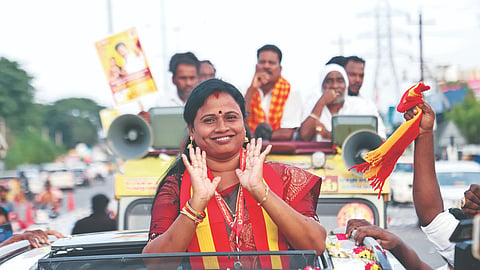
Vijay's campaign marked a departure from his relatively limited appearances during the Assembly elections. In Madurantakam, he undertook a 45-km roadshow covering more than 30 villages, interacting with residents and adopting conventional grassroots campaign methods. The intervention underscored TVK's attempt to move beyond its leader-centric, high-tech political image and build a conventional electoral organisation. However, the need for such sustained campaigning raises questions about the party's capacity to mobilise voters without its principal vote-getter.
A TVK leader who campaigned extensively in Dharapuram said the party had made inroads among sections of AIADMK grassroots workers but had failed to break the rival's rural vote base, attributing the resistance partly to the enduring appeal of the two-leaves symbol.
A senior TVK leader and minister dismissed concerns over the margins, predicting that the party would win more than 200 seats if Assembly elections were held again. Such confidence, however, remains a political assertion rather than a conclusion established by two bypolls.
The grapevine may be rife with speculation about further defections (from the AIADMK as of now), but attracting legislators is not the same as transferring their constituencies. Inexperienced cadres, candidates whose local appeal remains intertwined with their former affiliations and the entrenched networks of established parties remain formidable obstacles.
The victories have sustained TVK's momentum, but the bigger test is whether Vijay can turn personal charisma into a durable political machine that can win consistently without an intensive campaign.