
- Chennai
- Tamil Nadu
- India
- World
- EntertainmentEntertainment
- Business
- Sports
- Lifestyle
- Technology
- Videos
- Explainers
- Editor's Picks

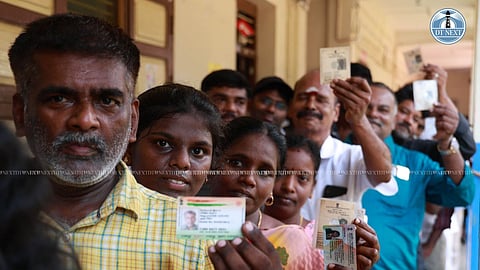
CHENNAI: Given the number of absentee voters who were removed from electoral rolls after the Special Intensive Revision (SIR) recently, it was a given that the polling percentage in Tamil Nadu would go up in this Assembly election. But even after factoring in the low-base effect, the polling has been vigorous on Thursday (April 23).
As long-time watchers of State politics may recall, elections are often held during the summer in Tamil Nadu, and polling drags during the noon hours when the heat peaks. It picks up pace in the evening hours after the temperature reduces and people come back from work. But not this time.
As of 3 pm on Thursday, 70 per cent of the 5.73 crore electors across Tamil Nadu have already cast their vote. To put this spike in perspective, it may be noted that the polling percentage around the same time in the 2021 Tamil Nadu Assembly election was only 53.55% - a jump of 16.45 percentage points. In fact, at this pace, turnout is fast approaching the final figure of 73.63% recorded in the 2021 polls.
1. Historically, higher polling percentage is a sign of anti-incumbency. In the recent years, however, higher polling has happened even in cases where the incumbent retained power, proving this theory to be fallible. Hence, it is too early to term this as a sign of voting out the government.
2. Youth are coming out in large numbers. Anecdotal evidence says this could be true, and claims abound that it is in favour of Vijay and TVK. But serious analysts warn of statistical biases like observer bias or confirmation bias, in which the observer notices only what suits the preconceived notion in their heads. Also, till the numbers come on May 4, any claims of conjecture by any party or leader, whether Vijay or Udhayanidhi Stalin, are only that: a conjecture.
3. SIR effect is sure to play a role in this election. During the recent purification of electoral rolls, as many as 97 lakh names were removed due to various reasons (death, duplication, shifting of houses, etc.) and 30 lakh were added. As a result, the total electorate number reduced by around 67 lakh – or 10.45 per cent. A basic back-of-the-envelope calculation shows that if all things remain the same from 2021, the polling percentage could jump by nearly 10 per cent this time around.