
- Chennai
- Tamil Nadu
- India
- World
- EntertainmentEntertainment
- Business
- Sports
- Lifestyle
- Technology
- Videos
- Explainers
- Editor's Picks
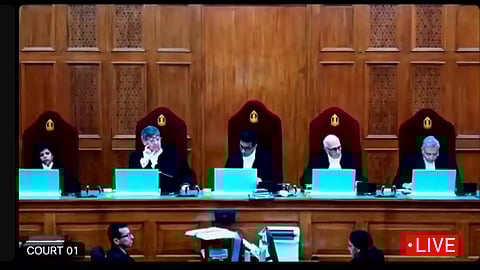
CHENNAI: The Supreme Court Constitution bench will deliver its judgement on Tuesday on various petitions pertaining to marriage equality rights for the LGBTQIA+ community.
The five-judge Constitution bench comprising of the Chief Justice of India DY Chandrachud, Justices Sanjay Kishan Kaul, S Ravindra Bhat, Hima Kohli and PS Narasimha is dealing with a batch of petitions pertaining to marriage equality rights for LGBTQIA+ community.
Advocate Arundhati Katju also said that they are waiting in anticipation of the judgement of the Supreme Court.
"It is a very big day and we are waiting in anticipation of the judgement of the Supreme Court. We've been waiting for this day for many years," Advocate Katju said.
Supreme Court’s five-judge Constitution bench assembles to begin pronouncing verdict on a batch of petitions seeking the right to marriage for LGBTQIA+ couples in India
CJI DY Chandrachud says there are four judgements. CJI says there is a degree of agreement and there is degree of disagreement in the judgements.
CJI DY Chandrachud says he has dealt with the issue of judicial review and separation of powers.
"The doctrine of separation of powers means that each of the three organs of the State perform distinct functions. No branch can function any others' function. The Union of India suggested that this court would violate the doctrine of separation of powers if it determines the list. However, the doctrine of separation of powers does not bar the power of judicial review. The Constitution demands that this court protect the fundamental rights of citizens. The doctrine of separation of powers does not come in the way of this court issuing directions for the protection of fundamental rights," CJI Chandrachud adds.
CJI Chandrachud says homosexuality or queerness is not an urban concept or restricted to the upper classes of society.
"The doctrine of separation of powers cannot stand in the way of the court issuing directions to protect fundamental rights. The court cannot make law but only can interpret and give it effect," says CJI Chandrachud.
CJI Chandrachud says homosexuality or queerness is not an urban concept or restricted to the upper classes of society....Queerness can be regardless of one's caste or class or socio-economic status.
CJI Chandrachud says it’s incorrect to say marriage is a static and unchanging institution. If the Special Marriage Act is struck down, it will take the country to the pre-Independence era, he adds.
To imagine queer as existing only in urban spaces would be like erasing them, queerness can be regardless of one's caste or class: CJI
Whether a change in the regime of the Special Marriage Act is required is for the Parliament to decide. This Court must be careful to not enter into legislative domain, says CJI.
CJI says, "This Court has recognised that queer persons are not discriminated against and their union cannot be discriminated against based on sexual orientation. All persons, including queer persons, have the right to judge the moral quality of their lives. The gender of a person is not the same as their sexuality."
Ability to choose life partner goes to root of right to life and liberty under Article 21, says CJI Chandrachud
CJI says material benefits/ services given to heterosexual couples & denied to queer couples will be a violation of their fundamental rights
CJI DY Chandrachud says that there is no material which proves that only a married heterosexual couple can provide stability to a child
CJI says the CARA circular not giving adoption rights to queer couples is violative of Article 15 of the Constitution
CJI directs the Union government and the State governments to ensure that queer people are not discriminated against on the basis of their sexual orientation
CJI directs Centre and State governments to ensure that there is no discrimination in access to goods and services to the queer community and government to sensitise public about queer rights. Government to create hotline for queer community, create safe houses 'Garima Grih' for queer couples who face violence and ensure inter-sex children are not forced to undergo operations.
Police should conduct a preliminary enquiry before registering an FIR against a queer couple over their relationship, says CJI DY Chandrachud on marriage equality case.
CJI states, "Right to enter into a union cannot be restricted on the basis of sexual orientation. Transgender persons in heterosexual relationships have the right to marry under the existing laws including personal laws. Unmarried couples, including queer couples, can jointly adopt a child."
Queer is a natural phenomenon known for ages, it is neither urban nor elitist, says CJI Chandrachud
"Union Government will constitute a committee to decide the rights and entitlements of persons in queer unions. This Committee to consider to include queer couples as 'family' in ration cards, enabling queer couples to nominate for joint bank accounts, rights flowing from pension, gratuity etc. The Committee report to be looked at Union Government level," says CJI Chandrachud
The Union Government, State Government and Union Territories shall not discriminate against the right of the queer community to enter into union, says Supreme Court.
Justice Sanjay Kishan Kaul says "Non-heterosexual unions are entitled to protection under the Constitution."
Justice Kaul says legal recognition of same-sex unions is a step towards marriage equality. However, marriage is not the end. Let us preserve autonomy as it does not impinge on others' rights.
Justice Ravindra Bhat says he does not agree with the directions issued by the CJI on the Special Marriage Act.
Justice Ravindra Bhat reading his judgement says, "There cannot be an unqualified right to marry which is to be treated as a fundamental right. While we agree that there is a right to a relationship, we squarely recognise that it falls within Article 21. It includes the right to choose a partner and enjoy physical intimacy with them including the right to privacy, autonomy etc. and should enjoy this right undisturbed from society and when threatened State has to protect the same. There cannot be any doubt that there is a choice to have a life partner."
Justice Ravindra Bhat says, "The Court can't put the State under any obligation when there is no constitutional right to marry or legal recognition of unions among non-heterosexual couples."
"Conferring legal status to civil union to queer people can only be through enacted law but these findings will not preclude the right of queer persons to enter into relationships," says Justice Bhat.
"There is no unqualified right to marriage except as it recognised under the law. Conferring legal status to civil union can only be through enacted law. Transsexual persons in homosexual relationships have the right to marry" says the Supreme Court on same-sex marriage
Supreme Court refuses to give marriage equality rights to the LGBTQIA+ community in India
| "I welcome the decision of the Supreme Court where they have not allowed same-sex marriage," says Supreme Court Bar Association president Adish Aggarwala.
#WATCH | Supreme Court refuses to give marriage equality rights to the LGBTQIA+ community in India
— ANI (@ANI) October 17, 2023
One of the petitioners and activist Anjali Gopalan says, " We have been fighting for long and will keep doing so. Regarding adoption also nothing was done, what the CJI said was… pic.twitter.com/2ZyjPmdvi7
***End of Live updates***
