
- Chennai
- Tamil Nadu
- India
- World
- EntertainmentEntertainment
- Business
- Sports
- Lifestyle
- Technology
- Videos
- Explainers
- Editor's Picks

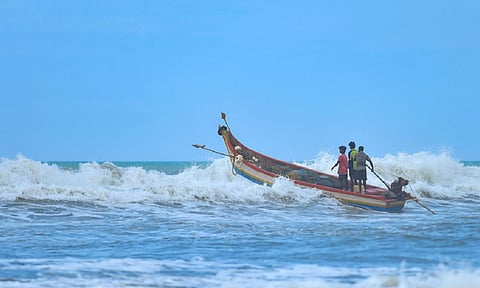
CHENNAI: Small-scale fishers in the Bay of Bengal are losing their livelihoods due to rising climate risks, including warmer seas, extreme weather events, and more frequent cyclonic disturbances, according to a Food and Agriculture Organisation (FAO) report.
The report, ‘Disaster Risks and Climate Change in the Bay of Bengal Region’ — prepared by the Bay of Bengal Programme Inter-Governmental Organisation (BOBP-IGO) and presented at a regional FAO meeting here — highlighted that climate-related storms are cutting 10-15 fishing days annually, affecting both income and food security of coastal households.
Marine heatwaves, projected to reach up to 250 days annually by the end of the century, could severely damage fish stocks and intensify extreme weather, the report said. "The same waters that sustained millions of livelihoods are now becoming more hostile and unpredictable," said P Krishnan, director, BOBP-IGO, presenting the findings.
Beyond the loss of fishing days, sea-level rise, storm surges, and saline intrusion are exposing coastal communities to higher risks, the report said, adding that poor access to insurance and limited safety compliance have increased fisherfolk's vulnerability to accidents and fatalities.
Krishnan emphasised the need to accelerate the implementation of BOBSAFE, a regional plan on fishermen's safety and working conditions developed by FAO and BOBP-IGO, endorsed in 2023.
Case studies from participating countries underscored the importance of mangrove restoration, disaster-resilient fishing villages, community-based early warning systems, climate-responsive credit, and relocation of erosion-prone settlements.
Experts at the meeting also called for stronger regional collaboration, shared data platforms, and policy coherence under the UN's Voluntary Guidelines for Securing Sustainable Small-Scale Fisheries.
The three-day meeting, jointly organised by FAO and BOBP-IGO, is being attended by policymakers, marine scientists, fisherfolk representatives, and officials from India, Sri Lanka, Bangladesh, and the Maldives.