
- Chennai
- Tamil Nadu
- India
- World
- EntertainmentEntertainment
- Business
- Sports
- Lifestyle
- Technology
- Videos
- Explainers
- Editor's Picks

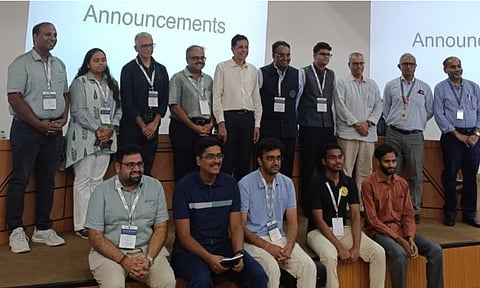
CHENNAI: Addressing IIT-M Centre for Responsible AI (CeRAI)'s 'Conclave on AI Governance', IndiaAI Mission CEO and Director General of NIC Abhishek Singh emphasised that India and the Global South's seat at the artificial intelligence high table was imperative to ensure the creation of an inclusive and participative framework.
Delivering the keynote address virtually for the IIT Madras Wadhwani School of Data Science and Artificial Intelligence (WSAI)'s event, Singh stressed that India's leadership in developing a responsible AI governance model could serve as a blueprint for emerging economies. "We have consistently championed a multi-stakeholder approach, bringing together governments, industry, academia, and civil society, to co-create frameworks that are inclusive and globally relevant," he said.
The conclave, an official Pre-Summit event of the India-AI Impact Summit 2026, witnessed the launch of several path-breaking initiatives, including a study titled "The Algorithmic–Human Manager: AI, Apps, and Workers in the Indian Gig Economy".
The report explores the growing role of AI in India's expanding gig workforce and its dual impact, enhancing efficiency and work accessibility while raising critical concerns about fairness, transparency, and worker dignity. It advocates a "pragmatic middle path", balancing innovation with robust digital safeguards to protect gig workers.
Other notable releases included a discussion paper on an AI Incident Reporting Framework for India, an interactive PolicyBot for accessible policy insights, the IndiCASA dataset to identify societal bias in large language models, a comprehensive AI Evaluation Tool for transparent performance assessment, and the Co-Intelligence (COIN) Network, a global collaborative ecosystem for AI-driven human augmentation.
In his inaugural address, V Kamakoti, Director of IIT Madras, underscored the need for "regulations that protect society without stifling innovation", adding that governance frameworks must evolve to keep pace with rapid technological change.
Highlighting the significance of responsible innovation, B Ravindran, Head of WSAI, said, "AI technologies demand a multi-pronged governance approach, involving voluntary commitments and stakeholder participation, to create a fair and human-centric AI ecosystem."