
- Chennai
- Tamil Nadu
- India
- World
- EntertainmentEntertainment
- Business
- Sports
- Lifestyle
- Technology
- Videos
- Explainers
- Editor's Picks

CHENNAI: For some senior residents in the city, boats ferrying goods and people on the Adyar and Cooum are a forgotten sight. For the younger generation, who witnessed the deterioration of the city’s rivers, it’s a distant dream.
The rivers, including Kosasthalaiyar, are Mother Nature’s gift to Chennai, which is located almost at the mean sea level.
Rivers carry flood water thus saving lives and properties. Now, Adyar and Cooum rivers are officially dead and Kosasthalaiyar in the north is following the path. Reason: indiscriminate discharge of untreated sewage and industrial effluents into the storm water drains that leads to the rivers.
For those fairly tired by the decades of wastage of money and resources spent for cleaning the rivers unsuccessfully, the rivers will remain dead.
But, global examples like the Seine River in Paris show opportunities.
Yes, the biochemical oxygen demand (BOD) in Cooum River between Avadi to Sathya Nagar was 345 mg per litre, which is the highest value among 603 rivers in the country that were assessed. On the other hand, Adyar river – between Tambaram and Nandanam – had a BOD value of 40 mg per litre. Kosathalaiyar is being polluted by industries and is infected by alien species.
However, concerted efforts of the government can clean the rivers. The government efforts improved the BOD levels in Cauvery, Bhavani, and Thamirabarani rivers to bathing standards. However, Chennai rivers require more than the government efforts as they are flowing amid a concrete jungle. Residents must stop letting their sewage into storm water drains and use treated water for gardening and other non-drinking purposes.
Can the rivers breathe again? Yes, literally.
After a restoration project in 358 acres, Adyar creek and estuary now house 424 species including molluscs, crabs, dragonflies, butterflies, fishes, amphibians, reptiles, birds and mammals. Before the restoration, there were only 141 species in the region.
RESTORATION OF WATERBODIES
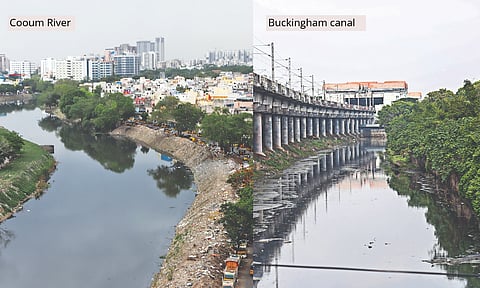
1. Cooum River
Integrated Cooum River Eco-Restoration Project (ICRERP)
Length: 65 km (of which ~20 km within Chennai city)
Confluence: Bay of Bengal, downstream of Napier Bridge
Acts as a major flood carrier for the city through its arms: Otteri
Nallah (10.8 km, north)
Virugambakkam–Arumbakkam drain (6.4 km, south)
Implementing Agency: Chennai Rivers Restoration Trust (CRRT)
Project Stretch: Paruthipattu to Bay of Bengal (32 km)
Administrative Sanction: Rs. 735.08 crore
2. Adyar River
Origin: Adhanur Lake near Guduvanchery, Chengalpattu
Length: 42 km
Course: Flows through Tambaram, Tiruneermalai, Manapakkam, Alandur, and Saidapet, before joining the Bay of Bengal near Adyar
Inflow: Surplus from Chembarambakkam Lake near Tiruneermalai
Districts Covered: Chengalpattu, Kancheepuram, Chennai
Implementing Agency: Chennai Rivers Transformation Company Limited (CRTCL)
Implementation Mode: Public-Private Partnership (PPP) under Hybrid Annuity Model (HAM)
Estimated Cost: Rs 1,500 crore
Status: Preparation of DPR underway
Duration: 30 months
Priority: Works between Saidapet and Thiru Vi Ka bridge to be completed within 15 months
Key Components
Sewerage Infrastructure: Installation of a 70 km-long sewerage pipeline along the riverbanks as an alternative channel for wastewater discharge Construction of 14 Sewage Treatment Plants (STPs) with a total capacity of 110 million litres per day (MLD)
3. Buckingham Canal
The Buckingham Canal is a major tidal waterway running parallel to the Coromandel Coast and interlinked with the Cooum and Adyar Rivers, playing a crucial role in stormwater drainage, flood mitigation, and navigation within Chennai city
Origin: From Pedda Ganjam in Andhra Pradesh to Marakkanam in TN (167 km from Pazhaverkadu in Tiruvallur district to Marakkanam in Villupuram)
Length: 420 km
Implementing Agency: Chennai Rivers Restoration Trust (CRRT)
Administrative Sanction: Rs 1,281.88 crore (Municipal Administration & Water Supply Department)
Funding: Chennai Rivers Restoration Trust (CRRT)
Allocation to WRD: Rs 1,014.28 crore for 35 works
4. Kosasthalaiyar River
Project objective is to achieve a holistic restoration of Chennai’s waterways by integrating the Kosasthalaiyar River into the city’s larger river restoration programme
Origin: Ammapalli Dam, Andhra Pradesh
Length: 136 km approx.
Confluence: Bay of Bengal at Ennore Creek
Implementing Agency: Chennai Rivers Restoration Trust (CRRT)
Project Stretch: Karanodai Bridge to Ennore Creek
Status: DPR under preparation