
- Chennai
- Tamil Nadu
- India
- World
- EntertainmentEntertainment
- Business
- Sports
- Lifestyle
- Technology
- Videos
- Explainers
- Editor's Picks
CHENNAI: A recent visit to the Government Kasturba Gandhi Hospital for Women and Children in Chennai revealed a stark picture of patient neglect, unhygienic conditions, and alleged corruption, raising serious concerns about the quality of care at an institution dedicated to vulnerable populations.
The distressing experience begins at the entrance itself, where visitors and patients are greeted by the overpowering stench of urine.
Further inside, the disregard for patient dignity was evident as cleaning staff were seen using mops to push patients’ footwear disrespectfully into a corner, as if disposing of garbage. The situation was particularly critical on the first floor, outside the High-Risk Obstetrics Unit.
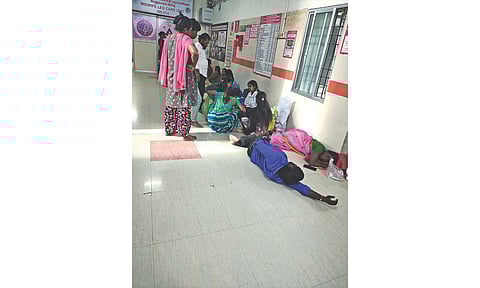
Several pregnant women, in active labour and awaiting delivery, were found sitting or even standing on the floor due to a lack of seating. Relatives were compelled to feed them meals in these undignified conditions.
Patients voiced grave concerns about the standard of care. One expectant mother, also seated on the floor, stated, “I am waiting for the pain to start. The staff here asks us to pay extra for small cleaning services, like Rs 100, even when it’s supposed to be fully free.” This accusation of bribery was corroborated by another patient.
Confusion also reigns over medical procedures, with some women reporting contradictory advice from doctors regarding the need for a caesarean section versus a normal delivery.
Basic amenities were found to be severely lacking. The drinking water supply was non-functional on the second and fourth floors, including the post-operative ward, forcing patients and their families to rely on packaged water bottles or fetch water from other floors. On the ground floor, only one of three water taps was working.
Adding to the hygiene crisis, a cat was seen roaming freely inside the ward, while stray dogs loitered on the hospital premises. In a final testament to the hospital’s inadequate facilities, a relative of a new mother revealed that after developing a post-delivery fever, she was referred to the Rajiv Gandhi Government General Hospital (RGGGH) because certain essential diagnostic tests were unavailable.
When confronted with these allegations, a senior hospital official stated, "The mentioned issues would be looked into and would be rectified within a week." For the countless women relying on this institution, this promised action cannot come soon enough.
