
- Chennai
- Tamil Nadu
- India
- World
- EntertainmentEntertainment
- Business
- Sports
- Lifestyle
- Technology
- Videos
- Explainers
- Editor's Picks

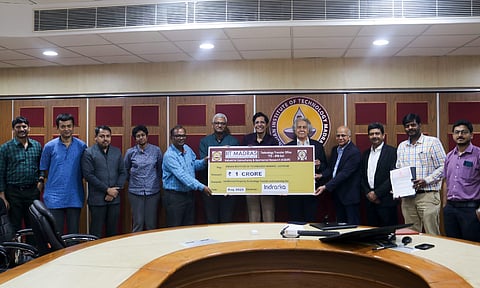
CHENNAI: The Indian Institute of Technology Madras (IIT-M) has developed India’s first silicon photonics-based high-speed Quantum Random Number Generator (QRNG). The licensing agreement, valued at Rs 1 crore, was signed on Monday between IIT-Madras’s Technology Transfer Office (TTO) and Indrarka Quantum Technologies for commercial deployment.
The technology was created at the Centre for Programmable Photonic Integrated Circuits and Systems (CPPICS), IIT-M. A prototype QRNG module was earlier delivered to DYSL-QT, DRDO, and an advanced version has since been deployed at the Society for Electronic Transactions and Security (SETS), Chennai, for quantum security applications.
The signing ceremony was presided over by IIT-M director V Kamakoti. The agreement was signed by Prof Manu Santhanam, Dean (IC&SR), IIT-M, Dinanath Soni and Tej Soni of Indrarka Quantum Tech, and Prof Bijoy Krishna Das, department of electrical engineering, IIT-M, who led the CPPICS team. Officials from MeitY, SETS Chennai, and industry partners participated in the event.
Pointing out that silicon photonics had a strong interface with quantum technologies, Kamakoti added: “Random number generation is a critical building block for secure computing and communication. The QRNG developed by CPPICS is ready for deployment.”
Soni stated the company would work to ensure field deployment of the QRNG across sectors, supporting national goals of self-reliance in technology. “The QRNG has applications in defence IT security, cryptographic algorithms, quantum key distribution, simulations, financial transactions, blockchain systems, OTP generation, and gaming,” he averred.
Prof Das, lead investigator at CPPICS, said, “The module represents the first silicon photonics-based product-of-its-kind from India, and this was made possible by the IIT-Madras faculty, researchers, and collaborating industry teams.”