
- Chennai
- Tamil Nadu
- India
- World
- EntertainmentEntertainment
- Business
- Sports
- Lifestyle
- Technology
- Videos
- Explainers
- Editor's Picks
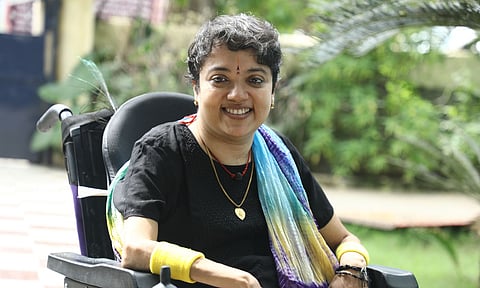
CHENNAI: Even after all the anguish and dejection, Preethi Srinivasan never fails to radiate her surroundings with her warm smile. Once the youngest player in the Tamil Nadu State Women’s Cricket Team and a state-level gold medallist in swimming, she was equally brilliant academically, ranking among the top two per cent of American students in 1996. As the only child in her home, life was picture-perfect until it took a major turn when she was 18.
“I was born to my parents nine years after their wedding. I had a privileged childhood, surrounded by love and care. I started swimming at the age of three. I wished to live in India but wanted a global education,” starts Preethi, who didn’t have the slightest idea how life would change.
She lived in the US from Class 10 and returned to India for college. “My father stayed in the US. My mother would be with me for a few months and with him for a few months. So, I enrolled in a five-year MBA course. I also got to study at the University of Lincolnshire and Humberside in the UK during my final year, which fueled my dream to join the national cricket team.” After a vacation in America, she returned to Chennai for an excursion to Puducherry in 1998.
“After playing tennis ball cricket on the beach, we decided to jump into the waves. The girls held hands and entered about three feet of water. A receding wave caused me to stumble, and I dove face-first into two and a half feet of water. I felt a shock sensation through my body,” she shares. In just 30 seconds without injury or bleeding, her life changed forever.
At the hospital, treatment was delayed for four hours as it was an accident case. “If there had been awareness about spinal cord injuries, the damage might have been less,” she says. “I was more scared of my mom scolding me for losing my contact lens, not knowing my world had changed.”
Preethi was moved to the US for treatment. “A year passed, and I was completely broken. I lost my identity as a swimmer and cricketer. I needed help to eat. In this world of billions, I felt invisible,” she says. Panic attacks followed, and she wished to escape reality.
Her parents were her backbone. “They never saw me as a burden.” When they reached out to Guru Yogi Ramsuratkumar, his immediate response was that she would be fine.
In 2000, Preethi and her parents came to India and stayed at the ashram. They settled in Tiruvannamalai, and tragedy struck again. “My father suffered a heart attack and passed away at 57. I was still discovering my new identity and suddenly had to take charge,” she says. Four days later, her mother also suffered an attack. With her mother facing a risky surgery, Preethi wondered where she would go if left alone.
“Even if I was ready to pay, there was no place to accommodate me. What about those who can’t afford care?” she asks. “Two disabled girls were forced to take their own lives. It shook me deeply.” This led her to start Soulfree, a public charitable trust, in 2013 to improve the lives of people with spinal cord injuries.
They soon realised that without structured rehabilitation, many were falling into despair and illness. That’s how Soulfree INSPIRE Rehabilitation Centre came to life with support from the Tamil Nadu government as India’s first integrated spinal rehab centre in a 20,000 sq. ft facility.
To better serve others, Preethi became the first woman with quadriplegia to earn a PhD from IIT Madras and likely the first in the country across IITs.
More than 300 people have undergone rehab there, becoming self-reliant through physical, psychological, and economic support. “This model can be replicated in other regions. Our challenge now is extending the lease, which ends soon.”
Despite the high numbers of spinal injuries, the government does not recognise it as a disability, a change Preethi is fighting for. “There’s no data, and paramedics don’t know how to manage such patients. We want dignity and respect. Soulfree is completely free, unlike expensive rehab centres.”
Explaining how it works, she says, “First, we restore the will to live, then build skills for income. It’s an experiential model.”
Mouth painting helped Preethi break free after a decade of isolation. She is a recipient of the Kalpana Chawla Award and several others. “If my story can bring hope, my purpose is fulfilled.”

Her dream is to build Soulfree Shambala Village, where people like her can live and die with dignity. Preethi believes that steady love and support of parents can make a big difference in the life of a child with a disability. “Yes, finances are a challenge. But when families reject us, it breaks us. We’re already struggling. Without support, it’s impossible to survive,” she concludes, noting that special children need special treatment.
To support Soulfree’s vision, visit www.soulfree.org or call 9994282299.