
- Chennai
- Tamil Nadu
- India
- World
- EntertainmentEntertainment
- Business
- Sports
- Lifestyle
- Technology
- Videos
- Explainers
- Editor's Picks

CHENNAI: When Officer Cadet Stanzin Tsangyang stood on the parade ground at the Officers Training Academy (OTA), on Saturday, she was carrying more than the rank badges she was about to receive.
The 23-year-old from Kargil was becoming the first woman Army officer from the district, a journey that began in the mountains of Zanskar in Ladakh.
“I was completely lost during classes 11 and 12,” she said, recalling that her career choices then seemed limited to engineering, medicine or law. She eventually chose engineering, pursuing Mechanical Engineering.
It was while in college, through the NCC, that she learnt more about the Indian Army. The more she learnt, the more convinced. “I knew from inside that this is what I want to do,” she said.
The Army’s active lifestyle and the scope to remain physically fit appealed to her.
Coming from a civilian family with no military background, she said the idea of becoming an Army officer was not something she had grown up around.
“There are many who are in the Army in Ladakh, but they are not officers,” she said.
Earlier, youngsters may not have known about the routes into the officer cadre or may have hesitated because of the difficult selection process and limited vacancies.
Stanzin also pushed back against a perception she said was sometimes held outside Ladakh that there is an inherent friction between the Army and local people.
“People of Ladakh respect the Indian Army too much,” she said. “Living close to the borders, residents understood the Army’s role in protecting their home.”
Colonel OPN Kalyan (retd) knows what it takes to enter the Army. His father joined in 1940; Kalyan himself was commissioned in 1969.
This time, it was his grandson Lt Rashwant preparing for the uniform. Originally from Orathy, a small village in Chengalpattu, he was so proud in continuing his family legacy. “It’s always been my dream to wear a uniform,” Rashwant said.
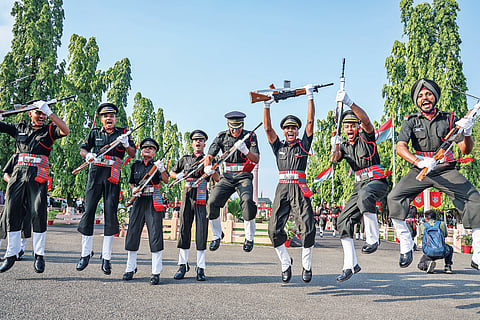
He was among 29 women and 313 male officer cadets commissioned into the Indian Army at OTA Chennai. Another 17 cadets from seven friendly foreign countries including Seychelles, Tanzania, Uganda, Zimbabwe, Eswatini, Bhutan and Lesotho completed their training.
The 122nd Passing Out Parade was reviewed by Chief of the Naval Staff Admiral Krishna Swaminathan who congratulated the newly commissioned officers and urged them to uphold the values of selfless service and the pursuit of excellence.
On the parade ground, many roots converged. Officer Cadet Mohit Arora from Phagwara in Punjab had spent seven years pursuing his Army ambition.
The son of an Army Postal Service veteran, he turned down admission opportunities at three IIMs to pursue his long-held goal of joining the Army.
Battalion Under Officer Sagar Bhadana came from an agrarian family near Faridabad with no military background. For another cadet, the uniform represented a family legacy. Officer Cadet Prashant Gurung grew up with the stories of his grandfather and father, both associated with the Gorkha Rifles.
And for Ritika Dubey, from a small village in Gorakhpur, the route involved scholarships, athletics and volunteering before she became the first member of her family to pursue a military career.