
- Chennai
- Tamil Nadu
- India
- World
- EntertainmentEntertainment
- Business
- Sports
- Lifestyle
- Technology
- Videos
- Explainers
- Editor's Picks
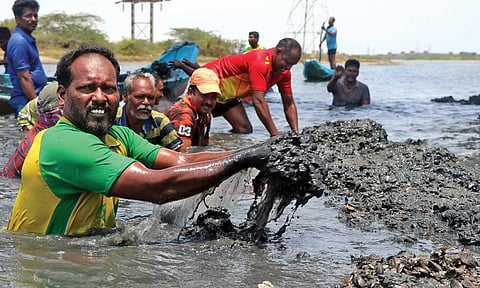
CHENNAI: As the authorities delay deciding on an effective mitigation strategy to remove the alien invasive species, Kakka Aazhi (Charru mussel), from the Ennore Creek and the Kosasthalaiyar estuary, about half of the families that depend on fishing at the estuary have shifted to alternative livelihoods.
According to a survey by the National Centre for Sustainable Coastal Management, while mapping the invasion of the Charru mussel, it has been observed that the economic impact on local livelihoods has been severe.
“The estuary, which sustains approximately 380 families, has seen 150 households shift to alternative livelihoods. Those who continue to fish report a sharp decline in income, Rs 5,000 to Rs 10,000 now, from Rs 30,000 to Rs 50,000 per month earlier. In some instances, efforts worth Rs 1,000 yield only Rs 500 in return,” the survey report said. During the survey, the NCSCM and local fishermen, who were included in the mapping process, found that 99 sampling points out of 249 have confirmed the presence of the Charru mussel, which is around 40 per cent.
Spatially, the mussels were most commonly found in specific ecological and anthropogenic niches such as areas beneath or adjacent to bridges, near estuarine mouths, in proximity to mangrove patches, within artisanal fishing zones, around tower structures, and near small-scale landing points.
“These findings suggest that the species may be capitalising on both natural habitats and human-altered environments to establish and expand its range,” the report added. It also warned against the dredging of the Charru mussel as a permanent solution and explained that dredging involves digging up sediment from the estuary floor, which can remove not only the invasive species but also eggs, larvae, and native animals living in the mud.
“It can destroy natural habitats where bottom-dwelling creatures live, causing some species to move away or struggle to survive. It also changes the shape and texture of the seabed, which can confuse fish, affect their feeding habits, and damage areas they use for shelter,” the report explained.
Moreover, dredging can even alter underwater sound patterns, making it harder for marine animals that rely on sound to find food or navigate. The sediment, stirred up, can release harmful substances like heavy metals, plastics, or excess nutrients, which can stress or kill aquatic life.
On the other hand, the Water Resources Department has already commenced dredging works to remove fly ash along a 1.7-km stretch at Rs 28 crore. Tamil Nadu State Wetland Authority has also sought the WRD and other departments to sanction funds to remove the invasive species through dredging.
Recently, chief secretary N Muruganandam directed the Fisheries department to quantify the monetary loss and aquaculture impact due to the Charru mussel and explore long-term policies and schemes for their management.
