
- Chennai
- Tamil Nadu
- India
- World
- EntertainmentEntertainment
- Business
- Sports
- Lifestyle
- Technology
- Videos
- Explainers
- Editor's Picks

As Tamils across the world celebrate Tamil Puthandu today (April 14), the day marks the start of the Tamil month of Chithirai. Observed with devotion and simple rituals, it is a time for new beginnings, prosperity and quiet reflection.
In Chennai, many are celebrating the festival while also looking back at the traditions and practices that have shaped their Puthandu over the years.
Historian Meenakshi Devaraj shares that getting the Panjangam from familiar vendors like Giri Traders and temples used to be the first and foremost activity for Puthandu. “Whenever a ceremony was planned at home, I remember elders saying ‘Panjangam eduthitu vaanga’ (bring the Panjangam) to check auspicious dates even before consulting a learned person. But now, not many of us know how to read it, and since it is available online, people don’t feel the need to buy it. I remember my grandmother showing us a square-like figure in the Panjangam and asking us to close our eyes and touch a box, each one carrying a small prediction,” she reminisces.
She also recalls how mukkani (three fruits - mango, jackfruit, and banana) and all six tastes were part of the Puthandu feast. “Like any other festival, the household would be filled with the aroma of different flavours. But now, many households are more focused on what restaurants are offering for the Puthandu virunthu,” shares Meenakshi.
After moving back to India from the US 16 years ago, dancer, storyteller and writer Ramaa Bharadvaj began aligning her routines with lunar and solar calculations based on the Vedic calendar. “I plan my activities according to the moon cycle rather than the English weekday. So, I celebrate my New Year in mid-April, when the Chithirai month begins, signalling the advent of Vasanta (spring), the first of six seasons. This is when the Sun begins its transit into Aries and continues through the 12 zodiac signs across the year. Aligning with this system helps tune our bodies to climatic shifts and our food habits also adapt to seasonal phases,” says Ramaa.
She explains the significance of the New Year’s feast. “It carries a spiritual lesson as well. The meal includes all six tastes: sweet, sour, bitter, salty, spicy and astringent. Pachadi made with raw mango and jaggery, along with a spicy broth with neem leaves, is an important part of the menu. It symbolises the different experiences, both sweet and bitter, that we must balance through the year.”
She notes that in 2026, we enter ‘Paraabhava,’ the 40th year in the 60-year cycle. “Some people are worried about the name, which means ‘defeat’ or ‘shame’. But a Sanskrit verse explains that it refers to those who rule poorly. So I think it is going to be a great year,” notes Ramaa.
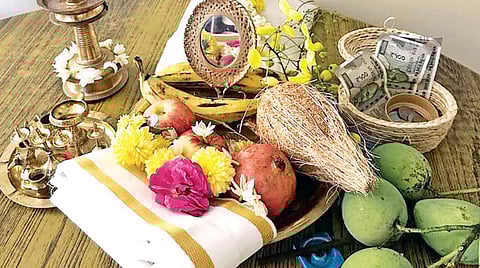
For artist Varshini Ramakrishnan, Tamil New Year celebrations at home are simple, cosy and rooted in familiar rituals. “The day begins with my mother drawing the ezha kolam at the entrance, with fresh mavilai hung above the door. My grandmother sets up the pooja with fruits, flowers, coconut and betel leaves, along with a mirror decorated with jewellery and coins. That quiet moment of looking into the mirror feels like a gentle, hopeful start to the year,” says Varshini.
She adds that the highlight is the elai saapadu, a wholesome feast with crispy vada, payasam, rice with sambar and rasam, along with panagam and neer mor. “Everyone gathers to eat together and sneaking a couple of hot vadas straight from the kitchen is always my dad’s favourite little tradition. After lunch, we take my grandmother’s blessings and the day slowly winds down. The TV plays in the background with a Tamil film, and we all drift into that inevitable afternoon nap. The celebration is nothing elaborate, just familiar, comforting and feels like a small, warm get-together. This year feels a little special and funny too, as my husband, who is Malayali, is celebrating Tamil New Year at my parents’ home, while I’m in Kochi at my in-laws’ place celebrating Vishu. It’s been lovely to see both festivals up close, the similarities, the small differences and the shared feeling of new beginnings,” concludes Varshini.