
- Chennai
- Tamil Nadu
- India
- World
- EntertainmentEntertainment
- Business
- Sports
- Lifestyle
- Technology
- Videos
- Explainers
- Editor's Picks

CHENNAI: Food has always had a magnetic pull on Chef Gokul. His grandmother and mother often recall how, as a child, he preferred kitchen utensils over toy cars, stirring imaginary pots while other kids raced around. That early fascination, he believes, shaped his unique way of looking at food.
Today, he travels across India studying regional cuisines, food history, indigenous vegetables, and how communities connect with what they eat.
“I grew up in West Mambalam, a Brahmin neighbourhood where I was exposed to so many different vegetables, greens and a very traditional way of life. We had this ‘keera amma’ who would come every other day with bunches of native greens. I’m not sure you see such sights in Chennai anymore.
Back then, vegetables were always seasonal. Now you get everything throughout the year. As a kid, we waited for certain vegetables to arrive each season, and that made us appreciate them so much more,” he begins.
After school, Gokul pursued his childhood dream, working in Michelin-star restaurants in the US. But returning to India during COVID changed everything. He launched a cloud kitchen called Hygge, inspired by the Danish idea of finding comfort in small things. “Hygge is that warm feeling you get from something simple, like rain,” he explains. He began with Mexican food, catering mostly to expats in Navallur, taking only 20 orders a day from his home kitchen.
After the lockdown, Gokul expanded to Chinese, Korean, and Japanese dishes with a weekly rotating menu. During this period, he noticed a worrying trend: seasonal vegetables were disappearing from markets, replaced by imported or exotic produce. “There was suddenly an influx of strawberries, blueberries, asparagus, and lettuce. Many native vegetables and fruits started vanishing.”
Gokul believes that while global ingredients brought excitement to Chennai’s food scene, they have also pushed many local vegetables into the shadows.
“People became fascinated with ingredients from outside, but somewhere along the way, we lost touch with our own produce. Farmers told me that few people were buying local vegetables, so they weren’t earning enough. We place ingredients from Japan, the US or France on a higher pedestal, but why not our own? They taste just as good, often better.
Our bodies are built for these foods; we’ve eaten them for generations. Eating seasonally gives us exactly what we need.”
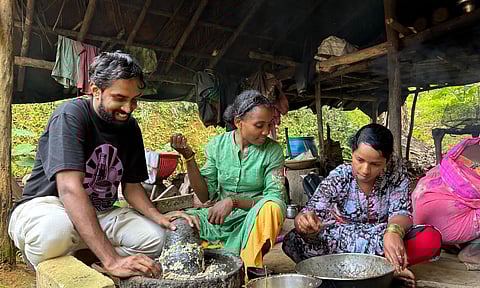
This concern set him off on a new journey. For the last year and a half, Gokul has been travelling across the country, documenting India’s food culture - what has disappeared, what remains, and what can be revived. “During my travels, I connected with several tribal communities.
If you want to understand the origins of food, you need to understand its history. Tribals are still closely linked to the forest and to their traditions. By studying their food, you get a glimpse of what our food culture might have looked like.”
His travels took him through Kerala, Andhra Pradesh and Tamil Nadu, where he observed their food practices and daily lives.
One community he is particularly fascinated with is the Malayar tribe. “They are one of the few tribal groups that still farm traditionally. They were the first to trade pepper with outsiders.
They grow many native root vegetables. One of them is ube, a yam that is hugely popular in the Philippines and the US. It grows in our forests in Tamil Nadu and Kerala, but most people here don’t even know it’s edible. It’s called kachil in Malayalam and vethalavalli kizhangu in Tamil. There are wide varieties, but almost no documentation.”
He points out several such ingredients that thrive right under our noses. For example, Calamansi, a citrus fruit common in the Philippines, Vietnam and Malaysia, grows abundantly along the ECR.
“People assume it’s an ornamental tree because the small orange fruits look pretty. But it’s an excellent cooking ingredient,” he says. Wild ginger, black turmeric, air potatoes and numerous other root vegetables are still used by tribal communities, even though many urban kitchens have forgotten them.
“We’ve lost touch with tradition in many ways. It’s good to adapt, evolve and welcome new ingredients, but not at the cost of ignoring our own. Just as the Japanese, Koreans or French take immense pride in their produce, we should take pride in ours. That’s why I started documenting everything,” shares Gokul.
Alongside ingredients, he studies techniques like fermentation, pickling, and curing, looking for patterns in how they evolved across regions. His research has taken him deep into Tamil cuisine. “Tamil cuisine is incredibly diverse. Sangam literature describes five distinct regions, each with its own ingredients and cooking methods.
In the hills, people relied on yams and hunted animals, so they developed strong preservation techniques. Chettinad, being dry, wasn’t ideal for rice, but the Chettiars were traders. They brought karuppu kavuni arisi from China and Malaysia. Even coconut milk, which we now associate with certain Tamil dishes, was introduced by the Chettiars. Traditionally, we used coconut, but not the milk, in our curries.”
He also documents the origins of traditional dishes like uppu kandam, uppukari, ratha poriyal, and ratha kootu. “These recipes tell stories of our history, geography, survival, and rituals,” he explains. In the future, Gokul hopes to open a restaurant that focuses on Tamil ingredients and techniques.
For now, he continues to host international pop-ups, using them as platforms to showcase Indian produce. “At my recent Korean pop-up in Bengaluru, I made gongura kimchi. People loved the tang and spice. It was beautiful to see their response. I also replace imported products with local alternatives. You don’t need arugula to make a salad when you can use spinach," concludes Gokul.