
- Chennai
- Tamil Nadu
- India
- World
- EntertainmentEntertainment
- Business
- Sports
- Lifestyle
- Technology
- Videos
- Explainers
- Editor's Picks

CHENNAI: A standup comic from Coimbatore, Shameem, hates being labelled as inspiring. "That is the last thing I wanna be," she says.
Shameem navigates the stand-up scene as a disabled woman comic, three years after being diagnosed with dystonia. She has been dealing with the locomotive disorder since childhood, though it was not diagnosed until many years later.
As dystonia restricts muscle movements, causing difficulties with physical actions, Shameem finds herself in a position where societal narratives often compel her into an 'inspirational' role, an expectation she explicitly rejects.
Shameem stresses how she could have navigated the diagnosis part more easily if there were enough conversations in the public domain on people with disabilities. With her standup, that remains her goal: to create a space for conversations. "My material is mostly based on my disability, and I love talking about it. I manage to create a space for those like me. They enjoy themselves and I feel heard.
"It's a great feeling when my humour lands well and creates laughter. However, some are sceptical of laughing. They hesitate, not knowing if they should be laughing," she says. As one of her jokes goes, “It is too tough being a disabled comic these days, because people get offended on my behalf.”
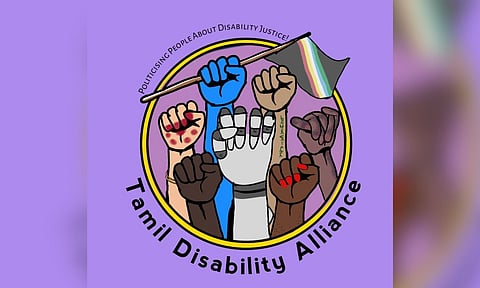
Naveen Daniel, a chronically disabled Dalit activist who founded Tamil Disability Alliance, also believes that art and pop culture should go beyond mere entertainment.
Daniel works towards calling out misrepresentations of the disabled in the mainstream media through their social media handles. By dismantling the damage done on one hand, it also builds a healthy community for people like him.
"We seek comfort and knowledge from the media. We seek community and representation. While they are supposed to make communication easier, wrongful representations only widen the gap. Bridging this gap is why the Tamil Disability Alliance came into existence," Daniel explains.
As many of the members could only meet virtually, the alliance regularly meets online. “We have online meetings, making it accessible for everyone. We conduct events, and people share their art, their criticisms, and their stories. It has grown into a support group,” he adds. Apart from this, Daniel has been into activism for 10 years.
"The primary reason this page exists is to politicise people. People are unaware. The majority of the troubles the community faces are due to ignorance. This is a small step in filling that gap. The society has its structures and laws that need to be enforced, and that only come through politicising the people," he says.
The journey to find himself was not an easy task for Daniel, though. The disorder Daniel suffers from restricts his movement severely. Most of his work is done virtually, so he had to drop out of school. He taught himself by reading as much as he could. He believes the community he has built will make it easier for those like him.
Harshini Ilaiveni, also part of the Tamil Disability Alliance, says the mainstream media should be sensitive as representations teach one about themselves. She is a professional filmmaker and photographer who suffers from chronic arthritis. "Movies have always misrepresented us, and I believe if they show us properly, it would have been much easier for us to navigate life." Either they are out there to be pitied, or there to be inspired by.
Shameem shares the sentiment. “I hate tropes that show us as people extraordinary; it sort of dehumanises us," she says. However, representations when done right seed hope in people.
Referring to Bangalore Days, Ilaiveni says, "I had never thought about being in a relationship. In general, there is so much difficulty in accepting oneself. I had never thought I would be able to fall in love. But Bangalore Days changed that notion; it made me envision a different reality for myself."
Art also lets us tell our own story, something necessary for more visibility and awareness. “We can tell our stories our way, something very important to change narratives”, she says.
Daniel believes sensitising people through art is easier. “Art makes things more accessible than any other medium could.” Quoting an anecdote from his life, he says, “I lived around children. While they were curious about my wheelchair, they were also judgmental. Not their fault, as they are never taught about us. But when they saw the art I made, it made them comfortable; the aesthetics warmed them up to me.”
Tamil Disability Alliance’s vision to create a space for conversations is slowly spreading its wings. The alliance is also open to everyone, not only the disabled. To become a good ally is easy, they say. “You have to be a good listener,” is the unanimous answer.
“Engage with art intuitively, call out when needed, mostly be a good listener to create space," says Daniel. Ilaiveni believes creation of a safe space in itself is a step towards allyship. Shameem asks people to stop jumping to conclusions that disabled people are extraordinary. “People think I am too smart because I am disabled, but I am not. I am no Stephen Hawking,” she says.