
- Chennai
- Tamil Nadu
- India
- World
- EntertainmentEntertainment
- Business
- Sports
- Lifestyle
- Technology
- Videos
- Explainers
- Editor's Picks
• “Are you going to resign?” read the words, scrawled on a scrap of paper and pushed through the letter box of a quiet London house.
Outside, reporters were demanding answers from one of Britain’s best-known weather forecasters, Michael Fish, who had just reassured viewers that a hurricane wasn’t going to hit Britain. Inside, his 11-year-old daughter, Nicola, bent down to collect the note.
“It was really shocking,” she said recently, sitting beside her father in the same home where the message landed 38 years ago.
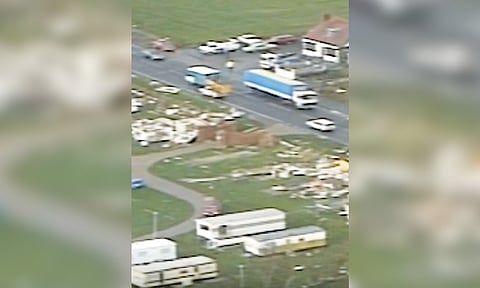
It was Oct. 16, 1987. By dawn, southern Britain’s landscape was unrecognisable. The country had been hit overnight by its fiercest storm in more than 300 years. Winds topping 100 mph tore through homes and countryside, felling 15 million trees, downing power lines, and killing at least 18 people. Damage exceeded 1 billion pounds.
Almost no one — not even Britain’s trusted forecasters — had seen it coming.
In Edenbridge, Kent, Julie Pell, heavily pregnant, had gone to bed after a calm forecast. When contractions began hours later, the wind rattled outside, but she thought little of it. When the power cut out, she and her husband, John, decided to drive to the hospital. The moment she opened the car door, she realised something was terribly wrong. “The car door nearly came right off,” she said. “I thought, oh my goodness, it is windy!”
Branches and cables whipped their car as they swerved around fallen trees. With labour intensifying and roads blocked, they turned back on foot. “I’d walk a few minutes and have to stop for a contraction,” she said. “You could barely tell where the road was.”
As the storm moved inland, London went dark.
For Tony Malins, then a manager with the electricity board, the chaos began when his bedside lamp wouldn’t turn on. Driving to the control center 25 miles away was a battle against the wind. “I couldn’t control the car,” he said. “I was worried I might not make it.” By the time he arrived, the entire southeast had lost power. If the storm had shifted farther north, he said, the whole country could have gone dark.
The Met Office’s annual report later noted that early forecasts had hinted at strong winds — but as the week went on, computer models dropped the storm. “They kind of lost it as we got closer,” said Alex Deakin, a current Met Office meteorologist.
Fish remembered the models showing the storm tracking over France. “I don’t think there was any inkling whatsoever that it would take a different track.”
That afternoon, Fish opened his BBC forecast with words that would make him infamous:
“Earlier today, apparently, a woman rang the BBC and said she’d heard there was a hurricane on the way. Well, if you are watching, don’t worry, there isn’t.”
Technically, he was right — a true hurricane requires warmer seas than Britain’s. But gusts reached 115 mph at Shoreham, with 80 mph winds lasting hours across the southeast.
Fish became the scapegoat. “I was actually quite pissed off!” he said. “The computer made the error — and it wasn’t fair to blame an individual.”
A government inquiry later cleared him, calling the backlash “grossly unfair.” In 1987, Met Office computers processed only 4 million calculations a second — slower than a modern phone — and satellite data were scarce.
At Met Office headquarters, meteorologist Phil Garner noticed barometric pressure dropping 10 millibars an hour. “That’s explosive cyclogenesis,” he said. “That was a storm happening.” But the machines couldn’t see it.
The storm, and Fish’s role in it, have lived on in British memory. His name remains tied to that extraordinary night, even appearing in the 2012 London Olympics opening ceremony. Time has softened the sting. “The British public is wonderful, actually,” Fish said. “They appreciate that you do a difficult job.”
For Julie Pell, the night ended differently. After trudging through the storm for two hours, she gave birth safely at home with a nearby doctor’s help.
Their baby girl was given a fitting middle name: Gayle.
The New York Times
