

Never again? Not quite...
The convention was drawn up in 1948, the year of Israel’s creation as a Jewish state. Now, through a twist of providence, Israel is being accused at the UN’s highest court of committing the crime so deeply woven into its national identity.
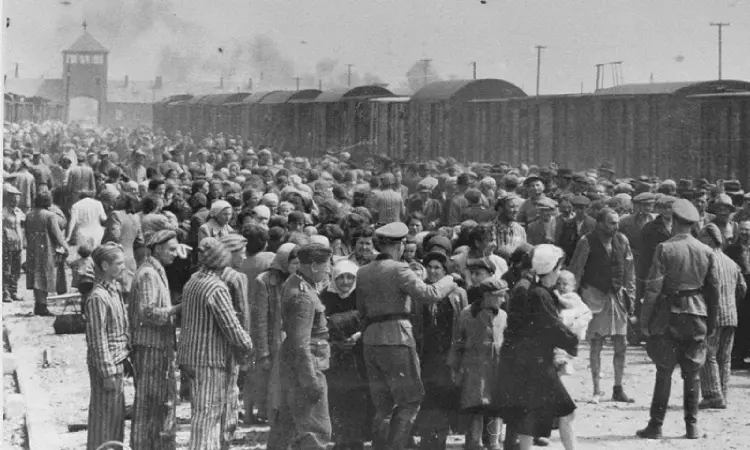
International Holocaust Remembrance Day observed on January 27, commemorates the victims of the Nazi pogrom between 1933 and 1945, when the Third Reich attempted to implement its Final Solution to the Jewish question. As many as six million Jews (or one third of the Jewish people), were massacred along with members of other minorities by the Nazi’s state-sponsored industrial killing machine. In the aftermath of World War II, the world pledged: Never again. That aspiration led to the drafting of a convention codifying and committing nations to prevent and punish genocide.
The convention was drawn up in 1948, the year of Israel’s creation as a Jewish state. Now, through a twist of providence, Israel is being accused at the UN’s highest court of committing the crime so deeply woven into its national identity. In response to Israel’s military offensive in Gaza triggered by the Hamas assault on October 7, South Africa approached the International Court of Justice and accused Israel of genocide.
On Friday, ICJ stopped short of ordering a cease-fire in Gaza, but demanded that Israel try to contain death and damage in its military offensive. The ICJ decided not to throw out genocide charges against Israel. The developments once again shed light on the question of genocide, and how it keeps cropping up in international politics decades after World War II. Like most evils, understanding it might hold the key to preventing its recurrence.
The critical element of genocide is intent — to destroy, in whole or in part, a national, ethnic, racial or religious group. But it’s tough to prove. In 2007, the ICJ ruled Serbia “violated the obligation to prevent genocide “ in the 1995 Srebrenica massacre, when Bosnian Serb forces rounded up and murdered some 8,000 mostly Muslim men and boys in the Bosnian region. There are two other genocide cases on the court’s docket. After Russia’s invasion of Ukraine nearly two years ago, Kyiv filed a case accusing Moscow of launching the military operation based on trumped-up claims of genocide and that Russia was planning acts of genocide in Ukraine. In this case, the ICJ instructed Russia to halt its invasion, which Moscow did not bother abiding by.
Another episode involves Gambia accusing Myanmar of genocide against the Rohingya Muslim minority. Gambia had filed the case on behalf of the Organization of Islamic Cooperation. It is worth noting that both Gambia and South Africa have filed ICJ cases in conflicts they are not directly involved in. The reason is that the genocide convention includes a clause allowing individual states — even uninvolved ones — to call on the UN to take action to prevent or suppress acts of genocide.
It will be interesting to note how the US, Israel’s top ally, responds to any order pertaining to the genocide, since Washington wields veto power at the UN Security Council and is in a position to block measures aimed at forcing Israel’s compliance. Washington has reiterated that Israel has the right to defend itself, while urging for protection of civilians in Gaza and allowing more aid in. The trepidation with which the global north has engaged with Ukraine during the Russian invasion — stopping short of deploying military personnel — is being mirrored in its hesitation on passing a judgment on Israel’s dis-‘proportionate’ response to the Hamas attacks. The notion of ‘never-again’ does not seem to have too many takers, at least in the Palestinian context.