
- Chennai
- Tamil Nadu
- India
- World
- EntertainmentEntertainment
- Business
- Sports
- Lifestyle
- Technology
- Videos
- Explainers
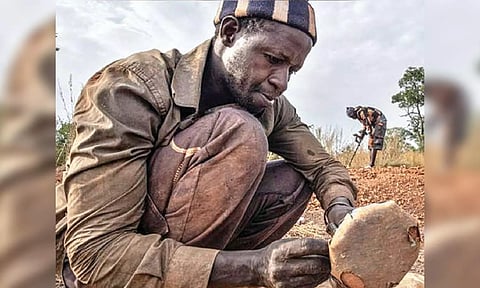
In the Kedougou region of southeastern Senegal, the gold rush starts just after dawn when the heat is still bearable and the sun is clement. Near the village of Samekouta, men with tired faces park their motorbikes on the edge of a vast, rocky plot of land surrounded by trees and high grass. Their clothes are covered in rust-colored dust. The artisanal mine comprises narrow black holes into which miners disappear with a swift hop. A permanent background noise of jackhammers and electricity generators covers their sparse conversations. The men are from Senegal, Mali, Burkina Faso and Guinea.
The latest report published by Senegal’s statistics agency states that gold production amounted to 387.7 billion CFA francs in 2020 (590 million euros), a figure likely greater if informal mining were considered. Estimates indicate that around 90% of the gold is taken abroad. “It’s mostly Malians and Guineans who buy the gold,” Aliou Cisse told DW in Faranding, a village on the shores of the Faleme River. He used to search for gold in the fields surrounding his village.
Kedougou, one of the poorest regions of Senegal, is home to over 20 nationalities. Foreigners, mainly from other countries in West Africa, come to Kedougou to try their luck in striking gold. Gold mining is not new in the region bordering Mali and Guinea. Farmers and villagers have practiced it on an artisanal level for decades, but since the 2010s, Senegal’s gold mining sector has grown considerably.
Locals searching for higher incomes moved from agriculture to small-scale mining on their lands. Word of the gold later drew foreigners in large numbers, and foreign companies set up industrial and semi-mechanized mines. The gold rush has come at the expense of the locals, some of whom have seen parts of their land grabbed and their environment polluted.
Cisse told DW his village has lost considerable land since a Chinese company set up a semi-mechanized mine on its outskirts. Power shovels now tirelessly excavate mounds of orange sand in the area where Faranging residents used to grow cereals and vegetables or search for gold. “For almost a century, our village has practiced agriculture, livestock farming and gold mining on this land. We were doing everything here, and the Chinese company came to occupy the space,” Cisse says.
The Faleme River, which people in Faranding say used to be crystal clear, is now a muddy orange. The Malian shore is only a few hundred meters away. A small wooden boat carries passengers from one side to the other. On its way, it passes a metal structure reaching onto the water from the Malian side. There, men operate dredging machines to extract rocks from the riverbed — yet another way to search for gold.
Mining companies dump thousands of liters of wastewater, sometimes containing chemicals such as mercury, into the Faleme. As a result, people living along the river can no longer drink the water or use it for their livestock or vegetable crops. Residents say they get little compensation, and industrial mining companies don’t offer enough jobs for locals. In a region where unemployment is rampant, gold mining has become an indispensable source of income.
Amadou Sega Keita, vice president of Kedougou’s departmental council, says around 300,000 people currently work in the mines, mostly on artisanal or clandestine sites. “You find people with master’s degrees there,” Keita told DW.
