
- Chennai
- Tamil Nadu
- India
- World
- EntertainmentEntertainment
- Business
- Sports
- Lifestyle
- Technology
- Videos
- Explainers

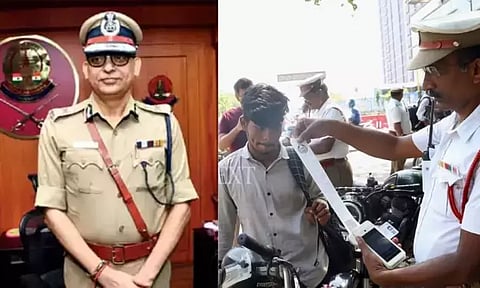
In an attempt to bring down the number of road accidents in Chennai, the city police had recently set a speed limit of 40 km/h for daytime commuters. The City Police Commissioner Shankar Jiwal said speed radar guns will be placed at 30 locations across the metro, and they will automatically issue challans if motorists cross the speed limit. Although the decision has now been revoked, it came on the back of a few innovations introduced to ensure the smooth functioning of the police’s traffic wing.
Two weeks back, the Greater Chennai Traffic Police unveiled the Vehicle Interceptor System with 360 degree rotatable cameras. In 10 days, it ended up booking over 3,900 cases. This is the first that a technology such as this has been deployed in South India. The system will also pick up traffic offenders indulging in triple riding and using cellphones while driving. However, there are many underlying issues that must be addressed to make driving in Chennai hassle-free.
The city’s urban planning officials must account for potential traffic snarls and parking violations before approving commercial and residential projects. A case in point is the critical Anna Salai stretch, which is home to several eateries/restaurants that are frequented by thousands of customers. Unfortunately, despite the law mandating that eateries need to be equipped with parking space, many of these outlets have patrons parking their vehicles on the road, which leads to congestion.
It’s the same story in residential neighbourhoods as diverse as Nungambakkam, Alwarpet, Koyambedu, Anna Nagar and Thiruvanmiyur. The city is home to over 21 lakh households, and over 8.4 lakh cars on the roads. But, thousands of residents are compelled to park their vehicles outside their premises on public roads. This is a fall-out of many small-time builders constructing homes without car parking facilities, prior to the introduction of RERA.
T Nagar is also prone to nasty traffic snarls in spite of the presence of a pedestrian plaza, and on-street parking management systems. One might recall how the multilevel car parking facilities introduced by the Chennai Corporation ran into rough weather, suffered from poor traction, and eventually were scrapped. A few stakeholders have since suggested bringing about legislation that permits people to buy four-wheelers only if their homes have parking spaces.
Even flyovers built to ease congestion have backfired in places like Velachery Main Road. The two new unidirectional flyovers were originally conceived as four lane stretches, but were designated as limited use flyovers due to land acquisition problems. Now, the two flyovers remain unused for the better part of the day, leading to a traffic deadlock under the structures, something that existed before the flyovers were built. Also, let’s not forget the pedestrians in this whole confusion. And, the lesser said about the cycling lanes, the better as most such lanes in Chennai have been encroached upon by motor vehicles itself.
But there’s light at the end of the tunnel. The Chennai Traffic Police’s live traffic monitor system, launched on Monday will provide the police with critical data to locate and troubleshoot issues on the fly. Going forward, we need to understand that traffic issues cannot be addressed in isolation. There needs to be action on both the State policy and legislation fronts, as well as the enforcement side to bring some method to this madness of traffic.