
- Chennai
- Tamil Nadu
- India
- World
- EntertainmentEntertainment
- Business
- Sports
- Lifestyle
- Technology
- Videos
- Explainers
- Editor's Picks
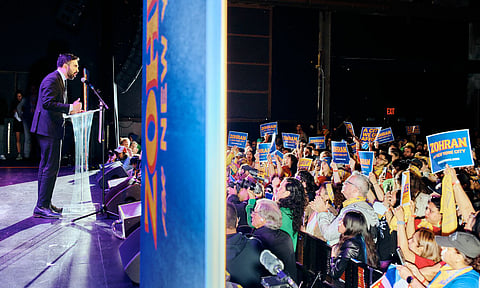
• Claiming victory as New York City’s next mayor, Zohran Mamdani began his speech with a nod to Eugene Debs, the 19th-century labour leader who once embodied American socialism. That mantle now falls to Mamdani, whose win handed the Democratic Socialists of America their biggest electoral triumph in its 43-year history.
Socialism had been a fixture in the US through the early 20th century before receding after World War II. When Debs died in 1926, Norman Thomas, a Presbyterian minister and anti-communist, carried the torch, running for president six times between 1928 and 1948. In 1932, he drew nearly 900,000 votes; Eleanor Roosevelt said she would have voted for him herself had her husband not been on the ballot.
By the 1980s, socialism survived mostly as punchlines in Woody Allen films. The notion of a socialist governing America’s largest city would have seemed absurd. “No one was under that kind of delusion,” historian Gary Gerstle said.
In 1984, Gerstle and fellow Princeton historians Sean Wilentz and Peter Mandler convened a conference on socialism to mark the centenary of Thomas’ birth. Its timing was unlucky: Ronald Reagan had just won a second term in a landslide.
Still, Wilentz recalled, “it was not an autopsy by any means,” though they were “honouring a guy and a tradition that could not have seemed more irrelevant.”
Gerstle predicted socialism’s appeal would take 25 years to return — an uncanny forecast. “I saw the New Deal being dismantled by Reagan,” he said, expecting that it would take decades before unregulated capitalism came under scrutiny again. The 2008 global recession proved him right, ushering in the rise of Bernie Sanders and, eventually, Mamdani’s generation of socialists.
Many attendees at that 1984 Princeton gathering were members of the Democratic Socialists of America, led by Michael Harrington. The bestselling author of The Other America (1962) — inspiration for Lyndon Johnson’s War on Poverty — Harrington had co-founded the DSA two years earlier.
His keynote, ‘Socialism in Our Time?,’ carried a note of doubt. Still, 450 people filled McCosh Hall to hear his outlook. Harrington argued that television had splintered the public’s attention so badly that producing another Norman Thomas would be nearly impossible. Thomas, he said, was a product of a culture attuned to listening. Harrington couldn’t have foreseen social media, but he was right that mastering the dominant medium would be vital to socialism’s revival — as Mamdani’s ascent has shown.
The tide began to shift during the 2016 Democratic primary. Sanders, a lifelong socialist but not a DSA member, rekindled national interest in the ideology. After Trump’s election, DSA membership quintupled from 2015 to 2017, reaching 32,000. Today, the group counts more than 80,000 members, and its demographics have transformed: the median age fell from 68 in 2013 to 33 just four years later.
The DSA itself was born in 1982 through a merger of Harrington’s Democratic Socialist Organising Committee, composed of Old Left veterans, and the New American Movement, rooted in 1960s campus activism. The Reagan recession was deepening, unemployment hovered near 10%, and socialists believed economic pain might boost their ideas.
But even then, debate raged over how radical to be and how closely to align with the Democratic Party. Harrington pushed what he called “visionary gradualism,” advocating reforms like federally guaranteed full employment. That tension — between incrementalism and revolutionary zeal — persists, with some young members deriding “Harringtonites” for moderation.
Early DSA activity focused less on electing Democrats than on voter drives and welfare debates, though there were bright spots. In 1982, Major Owens won the Brooklyn congressional seat vacated by Shirley Chisholm.
The organisation’s momentum soon faltered. Harrington’s demise in 1989 at 61 left the DSA without a unifying leader. Members like Cornel West and Barbara Ehrenreich were eloquent thinkers, but, as Phillips recalled, “Neither of them had the tolerance for the minutiae of organisational life.”
During those quiet years, few could have imagined the scene that unfolded last month at a beer garden in Astoria, Queens — Mamdani’s home turf. Hundreds of young supporters filled picnic tables, eating pretzels and drinking pilsners as they watched a mayoral debate on giant screens. Each time Mamdani attacked his rivals, the crowd roared as though cheering a college football team.
New York’s DSA chapter remains the nation’s largest, with more than 11,000 members — half joining in the past year, according to the group. The “Mamdani bump,” said chapter co-chair Gustavo Gordillo, has outpaced even the “AOC bump” that followed Alexandria Ocasio-Cortez’s rise.
Part of that surge stems from more creative outreach. New members are greeted not with bureaucracy but with community: running clubs in Queens and Chinatown, “Anti-Fascist Song Night,” and frequent social events. “You join the ACLU, but they don’t call you up and invite you for coffee,” Phillips said. In New York, DSA’s speed-dating nights have even become its most successful fundraisers.
Still, the influx of young activists has brought generational friction. Older members, like longtime socialist Miriam Bensman, say the younger crowd’s tone can be combative. “I’m not used to hearing people use Zionism as a swear word, almost,” she said. “There are many kinds of Zionism.”
Irving Howe, the social critic and early DSA leader, once said socialists might never seize power but would always have much to say. Now, they are speaking with new authority in a polarised world that seems to have caught up to some of their ideas.
After the 1984 socialism conference, Princeton’s alumni magazine asked publisher Malcolm Forbes — a Republican who’d helped fund the renovation of the university’s Norman Thomas library — whether he had any qualms about honouring a socialist.
“None,” Forbes replied. “Thomas was an absolutely great and farseeing American.”
The New York Times
