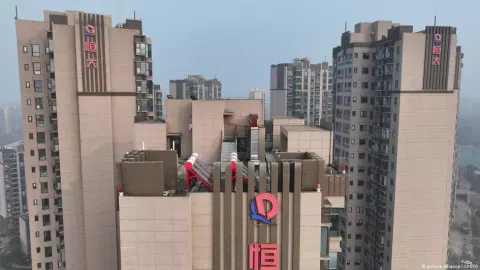

One of China’s largest real estate developers faces a winding-up petition in a Hong Kong court on Monday. A liquidation of the firm could have far reaching consequences for the world’s second-largest economy. Troubled property developer China Evergrande could be liquidated as early as Monday, as a court in Hong Kong hears a winding-up petition against the firm by foreign creditors. The legal proceedings are being brought by Samoa-registered Top Shine, an investor in one of Evergrande’s subsidiaries. A group of offshore bondholders also plans to join the petition to liquidate the company’s assets. A crackdown three years ago by China on two decades of real estate speculation caused a deepening property crisis and left Evergrande owing $300 billion (277 billion euros).
Months later, the firm defaulted on its offshore debt obligations, and a proposal to restructure its debt was rejected last month by creditors. The winding-up hearing was pushed to January after Evergrande’s lawyers argued that none of its creditors were seeking the liquidation of the firm, which has $240 billion of assets. But the judge warned that the most recent hearing would be the last before a decision was made on whether to issue the winding-up order, in the absence of a “concrete” restructuring plan. In a sign that liquidation is imminent, Bloomberg News reported this week that the court is set to seek a potential regulating order on Monday.
Firstly, the case is being seen as a test of whether a winding-up order issued in Hong Kong would be recognised in mainland China. Hong Kong’s system of common law, which has remained in place after the former British colony was returned to China in 1997, is preferred by foreign creditors when it comes to recovering debts in the mainland. Beijing agreed two years ago to recognise Hong Kong insolvency orders in the Chinese cities of Shenzhen, Shanghai and Xiamen.
But in practice, liquidation orders have been difficult to pull off due to China’s opaque legal system. Mainland courts have, to date, only recognised one such order, and have the ability to use their discretion over whether recognition is warranted.
If the order is accepted by a Chinese court, Evergrande would be placed in the hands of liquidators who would then try to sell off its assets to pay its creditors. The liquidators could propose a new debt restructuring plan to offshore creditors if they determined the company had enough assets. They would also investigate the company’s affairs and could refer any suspected misconduct to Hong Kong prosecutors.
Several other Chinese developers are facing winding-up orders in Hong Kong courts in the coming months.
The liquidation of Evergrande would be a major setback for the world’s second-largest economy, already struggling to recover from a draconian zero-COVID policy that kept much of the country in lockdown during the pandemic.
China’s real estate sector has been a major engine of growth over the past two decades, helping Beijing’s leaders to achieve double-digit economic growth at times.
In comparison, the Chinese economy grew just 5.3% last year, thanks in part to weaker exports and domestic demand, high youth unemployment and the worsening real estate crisis. In recent years, however, several other property developers have been forced into bankruptcy while spending by construction firms has dropped by 10% annually for two years running.