
- Chennai
- Tamil Nadu
- India
- World
- EntertainmentEntertainment
- Business
- Sports
- Lifestyle
- Technology
- Videos
- Explainers
By OLEKSANDRA INDYUKHOVA
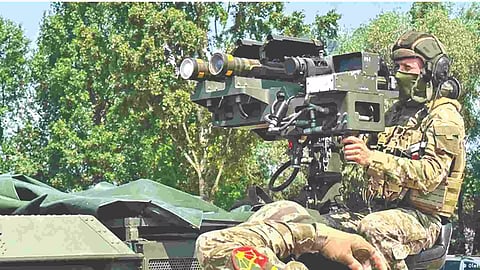
A few fishermen sat alongside a reservoir in the greater Kyiv area as families nearby on folding chairs enjoyed the sunny weather when a black and green Humvee military vehicle with a mounted Stinger anti-aircraft system suddenly pulled up. The people quickly packed their belongings and checked their mobile phones for a missile warning they might have overlooked. Two soldiers got out of the vehicle and reassured the people, saying it was only a mobile air defence unit exercise. Oleksandr, the commander, made it clear, however, that in the event of an air attack, everyone should leave the area immediately. “It is life-threatening to be out in the open near a body of water because from time to time, Russian missiles and Iranian Shahed drones fly along here, which we intercept,” the 36-year-old told DW. The other soldier, 39-year-old Ivan, walked the area fully armed, looking closely at everything on the water, on the opposite shore and in the surrounding area.
Ukrainian air defence forces have occasionally shot down targets from the side of the reservoir using a Dual Mount Stinger portable air defence system that can intercept missiles, planes and helicopters from a distance of five kilometers and at an altitude of up to three kilometers. The two men recreate a real combat situation they have practiced many times: They quickly pull boxes with missiles from the vehicle, open them and put the projectiles into the launcher. Oleksandr jumps onto the roof of the vehicle and inspects the airspace, spinning on a special seat.
“I can fire two missiles in five seconds,” he said. The radar signals a target in the air before he sees it, transmits coordinates and tells him where to aim. “Once I see the target, I get the ‘fire’ signal.” With the exception of the Russian Kinzhal hypersonic missile, Oleksandr said he could get pretty much anything out of the sky. Careful not to give too much detail, he said the air defence job takes “good eyesight and ingenuity.” The system might see a cloud above a drone as a target, in which case he has to think on his feet to actually get to the drone.
In recent weeks, most of the Russian missile attacks on Kyiv and the region occurred at night. Those were tense situations, Oleksandr and Ivan said, as it is much more difficult to detect targets, and there were far too many of them. According to Ivan, the Russian army aims to diminish the Ukrainian air defence stocks and weaken fighting morale. But they won’t succeed, he said.
“We have enough missiles and we have learned not to sleep at night,” Ivan said. Not everyone can stand the strain, said Oleksandr — not even soldiers. “I’m now used to staying awake for eight hours at night,” he said, adding he can fall asleep for a few hours in the afternoon because he knows the night might hold more attacks. Oleksandr struggled for words when asked about his feelings when he failed to shoot down a target. He said it is very difficult to note that a drone or missile has hit an apartment building, a kindergarten, a school or a hospital.
“I realize then that I failed to save lives. I am responsible for many lives,” he said, adding that’s why soldiers train constantly. For every enemy target they shoot down, they paint a trident, Ukraine’s national emblem, on their vehicle. Their Humvee sports 12 tridents. The Ukrainian Army’s Air Defence Command had never informed the media about the work of the mobile squads. Only now, after more than a year of war, has Oleksandr been allowed to talk about his experience. In the first months of the war, he shot down two Su-25 aircraft and two K-52 helicopters in the Kyiv region, he said, adding that helicopters are particularly difficult to hit because they deflect missiles with a laser.
This article was provided by Deutsche Welle
