
- Chennai
- Tamil Nadu
- India
- World
- EntertainmentEntertainment
- Business
- Sports
- Lifestyle
- Technology
- Videos
- Explainers
- Editor's Picks
The economic relationship between the United States and China is as fraught as it has been in recent memory, but that has not stopped a wave of Chinese food and beverage chains from moving aggressively into the US for the first time.
Chinese tea shops in New York and Los Angeles are offering consumers drinks topped with a milk or cheese foam. Fried chicken sandwich joints are trying to lure diners in California with affordable fast food. Restaurant and drink brands, some with thousands of stores in China, are taking root in American cities to escape punishing competition at home.
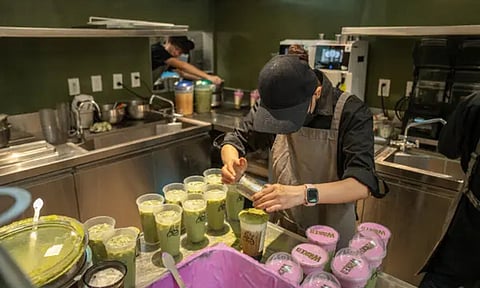
HeyTea, a tea chain originating in Jiangmen, a city in southern China, has opened three dozen stores nationwide since 2023, including a flagship operation in Times Square in New York. Two other rival tea brands, Chagee and Naisnow, opened their first US stores this year. Luckin Coffee, a chain with three outlets for every one Starbucks in China, opened several spots across Manhattan.
Wallace, one of China’s largest fast-food chains with more than 20,000 stores selling fried chicken and hamburgers, landed in Walnut, California, for its first shop. Haidilao, China’s largest hot-pot chain, is redoubling its efforts in the US after entering the market more than a decade ago.
The American expansion comes at a challenging moment for China’s food and beverage industry. The Chinese economy is no longer growing at a breakneck pace, hampered by a long-running real estate crisis and sluggish consumer spending. To survive, restaurant chains are undercutting one another on prices, inciting an unsustainable, profit-killing race to the bottom.
“China’s food service industry is suffering from severe oversupply,” said Bob Qing, the founder of Tomato Capital, a Chinese firm that invests in restaurants. In China, there are three times more food and beverage establishments per capita than there are in the US, according to Qing. And half the new restaurants that open in China close within a year.
Many Chinese fast-food restaurants have expanded internationally in recent years, especially in Asia, but the US, according to Qing, holds significant appeal because it is “the only market as mature and large as China.”
The transition to the US is not always smooth. The hot-pot chain Haidilao, which has a cultlike following in China, struggled when it first entered the market in 2013. It did not provide English-language menus. The prices were higher than customers had expected. And its trademark over-the-top service came across as intrusive.
In China, Haidilao’s staff provides free manicures to customers waiting for a table, performs noodle-making dances to entertain guests, and even peels shrimp by hand for diners. But the staff’s attentiveness was initially perceived as “eavesdropping” in the US, said Qu Cong, the chief financial officer of Super Hi International Holdings, Haidilao’s overseas business entity.
“For American customers, there’s a strong sense of boundaries, so simply copying the practices used in China might not work,” Qu said. Haidilao provided more guidance, in English, on how to navigate the hot-pot dining experience, in which diners dip various raw ingredients into a pot of boiling broth at the table. It tweaked the spice levels on some soup bases and expanded the beef selection.
The chain generated social media buzz over the summer when one of its restaurants appeared in the final episode of “And Just Like That…,” the sequel to “Sex and the City.” In the episode, the hostess sees that Carrie Bradshaw is dining alone and brings out “Tommy Tomato,” a plush doll, to fill the empty seat.
Chinese brands must weigh how much to cater to local tastes. When Wallace, a fast-food chain, opened its first US store last year, it stripped down its sprawling menu to focus mainly on fried chicken sandwiches. Ricky Chen, president of Wallace USA, said the standard chicken sandwich the company served in China came with lettuce and mayonnaise. For American diners, Wallace removed lettuce and added a pickle. It also made its food saltier.
Chen likes Wallace’s chances in the new market. “American fast food is getting too expensive,” he said.
Wallace does not hide its Chinese roots, Chen said. But it also does not promote them. At first, most of his customers were Asian because they were familiar with the brand. That has since changed. Wallace said it planned to open 10 more locations by the end of 2026.
Chagee, a tea brand that started selling shares on the Nasdaq stock exchange in May, said customers did not perceive it as a Chinese brand.
Qing, the restaurant investor and consultant, said that despite geopolitical tensions, the US had welcomed China’s food and drink brands. “This is one of the few industries in which people are still willing to engage in that kind of exchange,” he said.
@The New York Times
