
- Chennai
- Election-2026Election-2026
- Tamil Nadu
- National
- World
- Cinema
- Business
- Sports
- Lifestyle
- Technology
- Videos
- Explainers
NEW DELHI: The law will take its course’ is a favourite adage of Indian politicians in power. It is a sentiment, not a commitment. In practice, if it means anything at all, it is that the law will, like a brave river, try to run its course until sucked into the sands of the desert. But prior to the vanishing, its fury will be unleashed against whoever stands up to the regime. Of course, this use case of the law was practiced by all regimes prior to the present BJP-led dispensation at the Centre. The only difference since 2014 is that it is the default response of the regime to any criticism from any quarter.
The latest to attract the attention of the law thus are the writer Arundhati Roy and the Trinamool Congress MP, Mahua Moitra. The surprise in this is not that the regime has fixed these two women in its sights now, and before them, the entire journalist team of the website Newsclick, but that it waited so long to do so. In Roy’s case, the provocation for her prosecution, sanctioned by Delhi’s Lt Governor VK Saxena, is a speech she made 13 years ago. She is now to be tried for sedition for making clear her views on Kashmir, which she has written and spoken about openly for the better part of two decades.
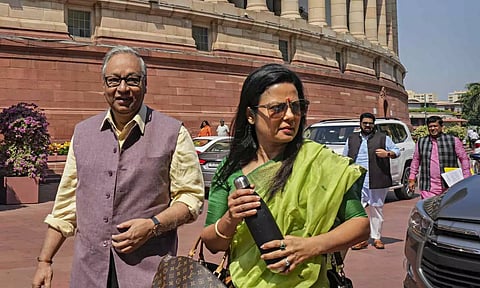
In Moitra’s case, the regime kept its composure for two years after she drew Parliament’s attention to the dubious investments pouring into the Adani companies and for eight fraught months after the Hindenburg report, blew the whistle on the dealings. The trigger, or opportunity, for the process against Moitra was a dispute between her and her former partner over custody of their pet Rottweiler. Moving fast after the estranged man filed an affidavit alleging that she took bribes from realtor Darshan Hiranandani for asking questions in Parliament, the CBI has secured a so-called confession from him. Although the realtor’s statement—allegedly on an non-notarised piece of paper—does not expressly confirm he paid bribes to the MP, the wheels of the law have ground urgently to put the feisty MP under an ethics investigation.
But all this is par for the course. Fervent legal action in this country never seems to lead to any denouement: Investigation is launched, ‘irrefutable evidence is leaked to the media, raids are conducted, ‘incriminating material’ is found and arrests are made in a few dizzy weeks, but then the case is lost in the labyrinth of the law. Manish Sisodia has been in detention for six months without the Delhi liquor investigation reaching anywhere near prosecution. Umar Khalid has been in incarceration for three years with the sedition case against him no nearer a verdict despite the ‘cast-iron’ evidence against him. Several of the Bhima Koregaon 16 accused have been in jail for six years, but the case remains in limbo.
The common man need not doubt whether the law is being upheld or used as a weapon against opponents of the regime. Figures self-declared by India’s apex law-enforcement agencies show that only about a quarter of the corruption cases taken up reach the chargesheet stage and only a small fraction of them lead to conviction in the courts. The law indeed may take its course, but does it ever reach the sea?