
- Chennai
- Election-2026Election-2026
- Tamil Nadu
- National
- World
- Cinema
- Business
- Sports
- Lifestyle
- Technology
- Videos
- Explainers
Almost every time Pope Leo XIV spoke publicly during his six-day trip to Turkey and Lebanon, he appealed for unity and an end to violence in a region often ruptured by conflict.
Perhaps less expected during the trip, which concluded Tuesday, he echoed one of the themes he set out in the first days of his papacy, calling out the risks of artificial intelligence and other rapidly advancing technologies.
“Even artificial intelligence simply reproduces our own preferences and accelerates processes that, on closer inspection, are not the work of machines, but of humanity itself,” the pope said just hours after he landed in Turkey last week. “Let us work together, therefore, to change the trajectory of development and repair the damage already done to the unity of our human family.”
Leo, the first pope from the US and the first baby boomer, is keenly aware of the promise and threat of the digital age. Even before this trip, he had spoken of the benefit of being able to connect with other Catholics around the world through social media and streaming platforms.
Pope Francis, Leo’s immediate predecessor, had also warned about the perils of artificial intelligence. Leo amplified those concerns from the start of his tenure, calling in his first address to Roman Catholic cardinals for the church to grapple with the risks that AI poses to “human dignity, justice and labour.” Since then, he has reminded lawmakers, AI developers, filmmakers, and actors that technology cannot substitute for the creativity and individuality of humans.
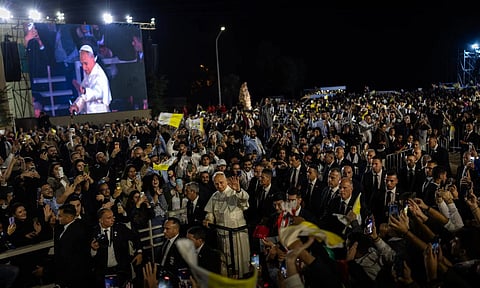
Leo’s Mideast trip — his first since he became pope more than six months ago — cemented his status as the first pope to fully embrace modern technology. Referring to him, Stephen Bullivant, a professor of theology at the University of Notre Dame Australia, said, “You have a sense that this is a man who got his smartphone when everybody else got it and it’s an embedded part of his life.”
Leo’s discussion of technology was part of a broader call for human connection. As might be expected from a pope whose first word after election was “peace,” he repeatedly emphasized unity and mutual acceptance as a path to overcoming conflict. He called for a two-state solution in Israel, the Gaza Strip and the West Bank; spoke with President Recep Tayyip Erdogan of Turkey about the war in Ukraine; and met with President Joseph Aoun of Lebanon.
Raising the issue of technology while confronting religious and geopolitical challenges suggested that Leo was searching for international allies in holding developers ethically accountable. “He sees this as an issue where hopefully he can make a difference,” Green said.
For many of the faithful, Leo’s attention to technology makes him an ideal pope. “We have this pope who is going to guide us through this incredibly turbulent technological time,” said Thomas Libeau, a web designer who traveled to see Leo in Turkey. His girlfriend, Irati Aguirre, said the pope knows how to reach younger people on the screens where they spend so much time.
In Lebanon, the message resonated with parents. “I actually appreciate that the pope is speaking up about AI because fast technology is changing everything,” said Nada Obeid, a bank teller in Beirut. “It reminds me how important it is for us parents to really pay attention to what our kids are doing.”
@The New York Times