
- Chennai
- Tamil Nadu
- India
- World
- EntertainmentEntertainment
- Business
- Sports
- Lifestyle
- Technology
- Videos
- Explainers
- Editor's Picks
CHARLOTTE GRAHAM-MCLAY
New Zealand’s annual bird election is contested by cheeky parrots, sweet songbirds, and puffball robins. This year’s winner, however, was a mysterious falcon that wouldn’t think twice about eating them.
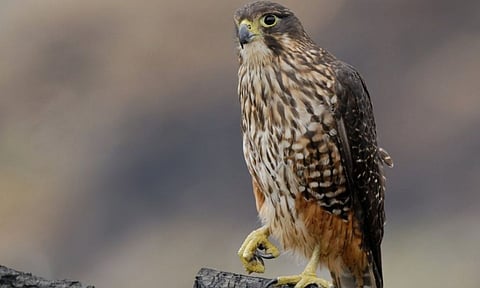
Kārearea, the Indigenous Māori name for the New Zealand falcon, was crowned Bird of the Year on Monday. Run by conservation group Forest & Bird, the contest is no ordinary online vote. Volunteer campaign managers stump for their chosen bird through meme battles, trash-talking posters, and dance routines in bird costumes.
“Bird of the Year has grown from a simple email poll in 2005 to a hotly contested cultural moment,” said Forest & Bird Chief Executive Nicola Toki. “Behind the memes and mayhem is a serious message.”
The poll highlights the plight of New Zealand’s native birds, 80% of which are threatened. In a country with no native land mammals apart from two bat species, birds dominate culture and identity. They appear in art, jewellery, songs, and even in the nickname New Zealanders carry abroad: “kiwis.” Locals adore alpine parrots that torment tourists and pigeons so drunk on berries they tumble from trees.
“This is not a land of lions, tigers and bears,” said Toki. “The birds here are weird and wonderful and not what you would expect in other countries.”
The first contest drew fewer than 900 votes; this year more than 75,000 New Zealanders participated. Only once, in 2023, did turnout run higher, after comedian John Oliver managed a campaign for the pūteketeke, or Australasian crested grebe, sparking mostly joking accusations of U.S. interference. His bird won in a landslide of 290,000 votes.
Controversies have long shadowed the competition. In 2021, uproar followed when a bat took the crown. In 2018, Australians cast hundreds of fraudulent votes for a bird whose name doubles as a slang term for sex, prompting stricter verification rules. Forest & Bird said 87% of this year’s votes came from New Zealand and that the falcon’s 14,500 tally was legitimate.
The kārearea is a majestic raptor capable of speeds over 200 km (124 mph), swooping on prey — often smaller birds. Though endemic, it is threatened by habitat loss and electrocution on power lines.
“They’re mysterious because they’re cryptic, often well-hidden,” said Phil Bradfield, trustee of the Kārearea Falcon Trust. He estimated between 5,000 and 8,000 remain, though the real figure is unknown. The “fast and sneaky and very special” bird, he said, deserved its win.
For other contenders, Monday’s results came as no surprise. Unfamiliar, uncharismatic, or simply plain birds struggle for votes, though that hardly deters enthusiasts. For the first time, all 73 avian competitors had campaign managers. Some championed birds they knew would lose.
One was journalist Marc Daalder, who ran a scrappy campaign for the tākapu, or Australasian gannet. His bird gained 962 votes — about one-fifteenth of the falcon’s. “Running a campaign for one of the less popular birds is more satisfying,” he said. “You know the votes your bird received are a result of your hard work.”
Despite the turnout, Toki worried that New Zealanders might lose faith in saving species that require costly protection from predators like cats, rats, and stoats. “Successive governments have cumulatively reduced investment in conservation, which is the cornerstone of New Zealand’s economic prosperity,” she said, noting that tourists come to see birds and wild landscapes, not malls.
