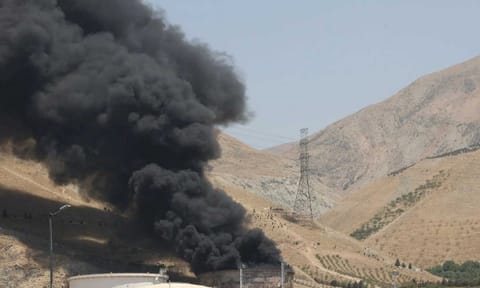

President Donald Trump’s repeated suggestions in the aftermath of Israel’s attack on Iran that Tehran should “make a deal before it’s too late” have been met with widespread mockery on social media and among experts who follow Iran.
With the bombs falling, it already feels like the moment for diplomacy has passed, and sure enough, Iran cancelled the negotiations that were scheduled to take place last weekend in Oman and its foreign ministry has insisted that any dialogue would be “meaningless” after the United States allowed Israel’s “barbarous” attacks on Iran to take place.
Imagining how Iran could come back to the table after being so brutally attacked is admittedly difficult, until you think about how bad its other options are.
With much of its top military leadership eliminated, air defences devastated, missile production and delivery systems taken out and regional proxies largely disabled, escalating or engaging in a long war against Israel will not turn out well for Tehran. To race to produce a nuclear weapon — perhaps tempting as a last resort to restore deterrence — would very likely bring the US directly into the conflict, including with its bunker-busting bombs that could destroy Iran’s best-protected underground uranium enrichment site. Attacking Iran’s neighbours’ oil production facilities or exports would reverse the recent thaw in regional relations and could invite military retaliation by leaders long eager to get rid of the Iranian regime. Launching terrorist or cyberattacks on Israeli or US targets could cause significant pain and damage, but would be unlikely to undermine either nation’s resolve and could do the opposite.
For now, Iran seems intent on just trying to drag out the conflict, impose immediate costs on Israel and hope that President Trump, fearful of escalation, will eventually pressure Israel to call off the war. But that could mean many weeks of continued Israeli bombing.
Given Iran’s awful options, offering Trump the negotiated nuclear deal he wants might ultimately not look so bad to Tehran. Such a deal might not resemble the one Iran thought it could get as recently as a few days ago or even be as attractive as the 2015 nuclear deal Trump tore up, but it might well be better than no deal at all. Notably, while cancelling the negotiations in Oman, Iran took care not to rule out further talks.
A central point of contention in the US-Iran nuclear talks, which began in April, has been whether Iran can continue to enrich uranium domestically, for civilian purposes. In a new nuclear deal, Iran could commit to Trump’s long-term goal of zero enrichment in exchange for the right to continue limited and monitored enrichment for a limited period of time. At the end of that time, Iran would agree to participate in a regional enrichment consortium the Trump administration has proposed — perhaps even to be built on a neutral site or even a disputed island in the Gulf that Iran could claim as “Iranian soil.” That would guarantee Iran’s access to fuel if it ever does build the civilian nuclear reactors it claims as the reason for its nuclear program. The details and the consortium itself would take some time to be finalised, but an agreement in principle could buy time to allow Iran to save face and provide a pathway to end the current war.
If he got such a deal, Trump could claim to have gotten a better nuclear deal than President Barack Obama, whose nuclear deal permitted Iranian enrichment, and would finally have the kind of big diplomatic win that has eluded him in Ukraine and Gaza.
Iran has limited leverage to demand a continuation of enrichment for even a fixed period. But the Trump administration might go along with that, given the threat of continued missile strikes on Israel, which have now already killed Israeli civilians, shut Israeli airspace and taken a toll on its economy. Other factors include the possibility of proxy attacks on US forces in Iraq and Syria, growing international condemnation of Iranian civilian casualties at the hands of Israel and the risk that Iran could weaponise its large, still-existing stockpile of 60 per cent highly enriched uranium.
Getting Israel onboard would be another matter, but Trump must remain wary about allowing the United States to get dragged into the sort of enduring Middle East war he vowed to avoid and losing the support of part of his “America First” base. He has already shown a willingness to split with Prime Minister Benjamin Netanyahu of Israel when it is in his interest to do so. If Trump wants to do a nuclear deal with Iran, he can do so, whether Netanyahu — who needs US support to continue the war — likes it or not.
Agreeing to an eventual end of domestic enrichment would be a historic climbdown for Iran, maybe more than is politically possible after investing so much in it for decades. But it could also provide potentially regime-saving economic relief and stave off an escalating military conflict that is already destroying Iran’s prized enrichment capability and seems likely to end badly for the regime in Tehran.
If Ayatollah Ali Khamenei, Iran’s supreme leader, is unwilling to explore such a deal, perhaps someone in Iran’s new military leadership — well aware of the dearth of alternative options and the unequal military balance with Israel — might take a different view.
The current situation is dynamic and uncertain, and if Iran can somehow turn the tide militarily or get away with covertly developing a nuclear deterrent, maybe it can emerge strong enough to avoid having to compromise. But that seems unlikely at the moment. In the wake of military humiliation by Israel, and in the face of potentially darker days ahead, a new nuclear deal might ultimately prove to be Iran’s worst option — except for all the others.
©️The New York Times Company