
- Chennai
- Tamil Nadu
- India
- World
- EntertainmentEntertainment
- Business
- Sports
- Lifestyle
- Technology
- Videos
- Explainers
- Editor's Picks
NEW DELHI: US President Donald Trump’s doubling of tariffs on a wide range of Indian goods, from a steep 25% to a catastrophic 50%, is reshaping India’s export economy.
Half of what India sells to the US – its largest trading partner – is now prohibitively expensive, and ordinary Indians are suffering as a result.
Over the last two decades, India’s share of global exports has inched up from 1.2% in 2005 to 2.4% in 2023. That modest figure masks the painstaking efforts of exporters, policymakers, and workers who recognized that trade plays a critical role in enabling countries to climb the development ladder.
Trump’s tariffs now threaten to knock India down a few rungs – or worse.
The figures speak for themselves. In September – the first full month of the tariffs – India’s merchandise trade deficit widened to a 13-month high of $32.15 billion, up from $26.49 billion in August, as exports to the US fell to $5.4 billion from $6.9 billion the previous month.
Trade deteriorated further in October, with India’s goods exports to the US falling 9% year on year.
This is not an abstract macroeconomic story.
Bearing the brunt of the tariff shock are India’s labour-intensive industries – textiles, apparel, leather, gems and jewelry, footwear, handicrafts, and seafood – which employ tens of millions of workers, including many women and first-generation industrial employees.
While the US administration engages in geopolitical power plays, these workers are worried about feeding their families.
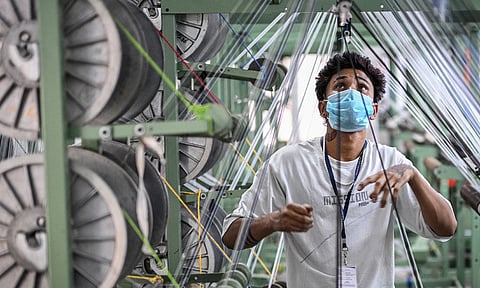
The textiles and apparel sector – one of India’s most globally competitive – has been dealt a particularly heavy blow. In 2024-25, India exported $10.9 billion worth of such goods to the US, which accounts for 35% of India’s total apparel exports.
Margins in this industry were already wafer-thin, often in single digits. The sudden surge in tariffs – from 13.9% to a staggering 63.9% – has effectively shut Indian garments out of their largest market.
Producers cannot simply wait out the tariffs. Bangladesh and Vietnam are stepping in to supply garments, denim, and man-made fibres to US consumers; Pakistan is gaining ground in denim and fleece; Cambodia is emerging as a hub for fast-fashion knits.
The US is also the largest market for Indian carpets and rugs, accounting for nearly 60% of the sector’s exports. But US tariffs on these products have now skyrocketed from 2.9% to 52.9%, driving consumers toward goods from Turkey and China, as well as Turkish-owned mills in Egypt. The same dynamic is playing out in leather.
No sector has been hit harder than jewellery. In September, exports of gems and jewelry to the US from Mumbai’s Santacruz Electronics Export Processing Zone plummeted by 71-76% year on year.
Behind this statistic are thousands of artisans, polishers, and small-scale entrepreneurs who suddenly have no orders, no incomes, and no livelihoods.
Many exporters saw the tariffs coming and tried to frontload shipments. That is why India’s exports to the US grew 13% year on year during the first half of the current fiscal year, reaching $45.8 billion. But once the full tariff regime took effect, new orders dried up. The stopgap strategy bought time, but it could not buy resilience.
Reducing India’s vulnerability to trade shocks, particularly those emanating from the US, demands a carefully planned diversification strategy. India should increase its trade linkages within the Global South, taking advantage of growing demand for textiles, leather, and processed foods in Africa, Latin America, and Southeast Asia.
It should also work with neighbours like Bangladesh, Sri Lanka, and Nepal to create integrated regional textile and apparel supply chains, ensuring it remains part of the global garment story even if direct exports to the US shrink. India should push harder to operationalize existing free-trade agreements – including with Australia and the UAE – thereby gaining access to markets capable of absorbing some of the exports that previously went to the US.
But diversification cannot happen overnight, and for now, there is no substitute for tariff relief from the US. While a full reversal appears unlikely soon, India might secure sector-specific reductions through diplomacy. Gems and jewelry, for example, could be pitched as a niche sector in which Indian craftsmanship benefits American consumers.
Trump’s tariffs have laid bare the fragility of India’s export model, which relies on a handful of markets and a narrow band of relatively low-value-added products. Only by embracing a new approach – emphasizing diversification, regional cooperation, value addition, and domestic demand – can India emerge from the current upheaval stronger, more resilient, and better equipped to chart its own path.
