

Democracy under pressure like never before
The protests, however, quickly took a turn when key Congress lawmakers led by Rahul Gandhi Modi’s main opponent in the last two general elections trooped to the Parliament, leading to fierce standoffs with police.
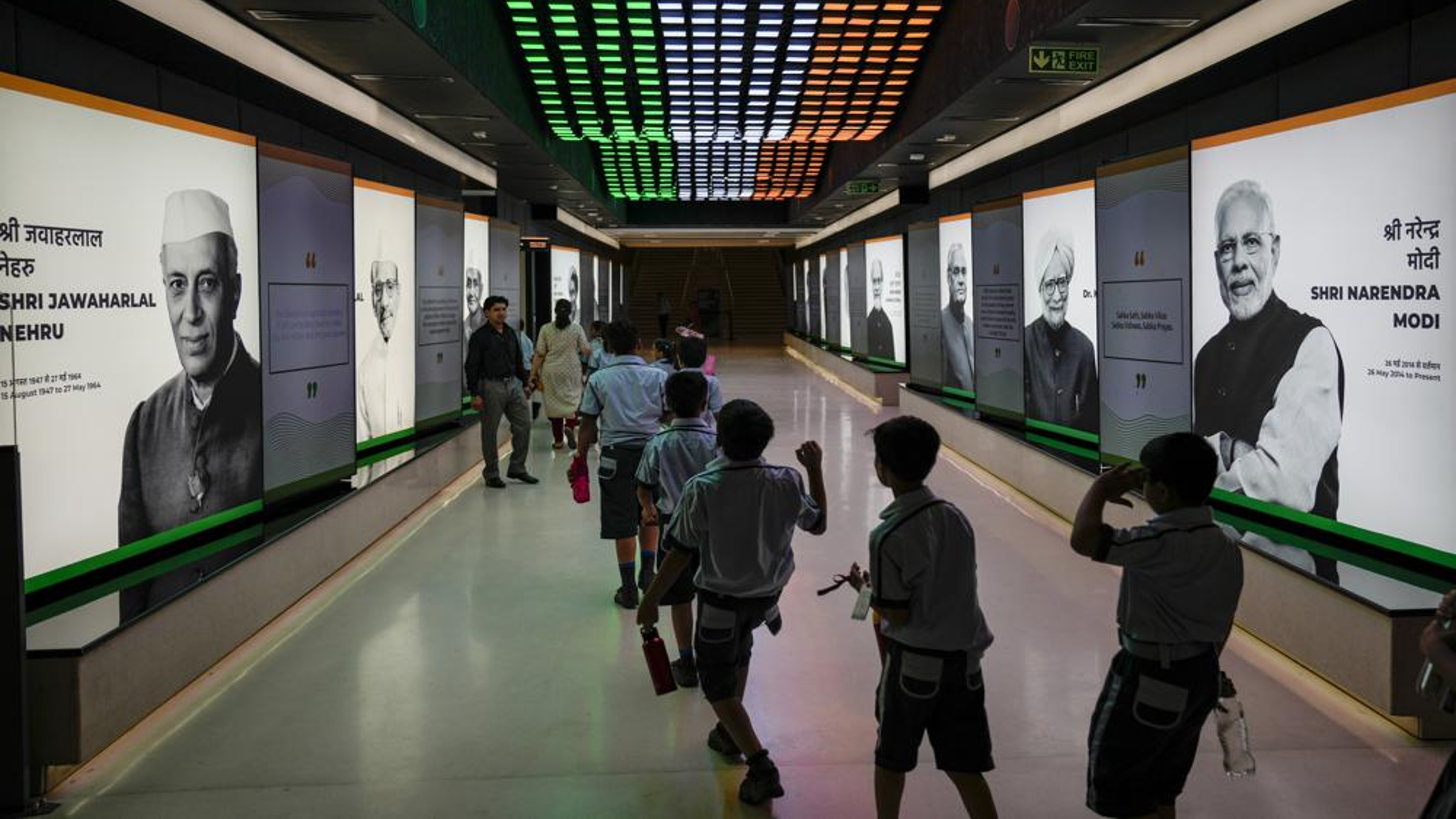
NEW DELHI: The Aug. 5 demonstrations by India’s main opposition Congress party against soaring food prices and unemployment began like any other recent protest an electorally weak opposition taking to the New Delhi streets against Prime Minister Narendra Modi’s massively popular government.
The protests, however, quickly took a turn when key Congress lawmakers led by Rahul Gandhi Modi’s main opponent in the last two general elections trooped to the Parliament, leading to fierce standoffs with police.
“Democracy is a memory (in India),” Gandhi later tweeted, describing the dramatic photographs that showed him and his party leaders being briefly detained by police.
Gandhi’s statement was largely seen as yet another frantic effort by a crisis-ridden opposition party to shore up its relevance and was dismissed by the government. But it resonated amid growing sentiment that India’s democracy — the world’s largest with nearly 1.4 billion people — is in retreat and its democratic foundations are floundering.
Experts and critics say trust in the judiciary as a check on executive power is eroding. Assaults on the press and free speech have grown brazen. Religious minorities are facing increasing attacks by Hindu nationalists. And largely peaceful protests, sometimes against provocative policies, have been stamped out by internet clampdowns and the jailing of activists.
“Most former colonies have struggled to put a lasting democratic process in place. India was more successful than most in doing that,” said Booker Prize-winning novelist and activist Arundhati Roy. “And now, 75 years on, to witness it being dismantled systematically and in shockingly violent ways is traumatic.” Modi’s ministers say India’s democratic principles are robust, even thriving. “If today there is a sense in the world that democracy is, in some form, the future, then a large part of it is due to India,” External Affairs Minister Subrahmanyam Jaishankar said in April. “There was a time when, in this part of the world, we were the only democracy.” History is on Jaishankar’s side.
At midnight on August 15, 1947, the red sandstone parliamentary building in the heart of India’s capital echoed with the high-pitched voice of Jawaharlal Nehru, the country’s first prime minister.
But experts and critics say the country has been gradually departing from some commitments and argue the backsliding has accelerated since Modi came to power in 2014. They accuse his populist government of using unbridled political power to undermine democratic freedoms and preoccupying itself with pursuing a Hindu nationalist agenda.
“The decline seems to continue across several core formal democratic institutions... such as the freedom of expression and alternative sources of information, and freedom of association,” said Staffan I. Lindberg, political scientist and director of the V-Dem Institute, a Sweden-based research center that rates the health of democracies.
Modi’s party denies this. A spokesperson, Shehzad Poonawalla, said India has been a “thriving democracy” under Modi’s rule and has witnessed “reclamation of the republic.”
Most democracies are hardly immune to strains. The number of countries experiencing democratic backsliding “has never been as high” as in the past decade, the International Institute for Democracy and Electoral Assistance said last year, adding the U.S. to the list along with India and Brazil.
Still, the descent appears to be striking in India. Earlier this year, the U.S.-based non-profit Freedom House downgraded India from a free democracy to “partially free.” The V-Dem Institute classified it as an “electoral autocracy” on par with Russia. And the Democracy Index published by The Economist Intelligence Unit called India a “flawed democracy.”
India’s Foreign Ministry has called the downgrades “inaccurate” and “distorted.” Many Indian leaders have said such reports are an intrusion in “internal matters,” with India’s Parliament disallowing debates on them.
Globally, India strongly advocates democracy. During the inaugural Summit for Democracy organised by the U.S. in December, Modi asserted the “democratic spirit” is integral to India’s “civilisation ethos.”
At home, however, his government is seen bucking that very spirit, with independent institutions coming under increasing scrutiny.
Experts point to long pending cases with India’s Supreme Court challenging the constitutionality of key decisions taken by Modi’s government as major concerns.
They include cases related to a controversial citizenship review process that has already left nearly 2 million people in Assam state potentially stateless, the now revoked semi-autonomous powers pertaining to disputed Kashmir, the opaque campaign finance laws that are seen disproportionately favouring Modi’s party, and its alleged use of military-grade spyware to monitor political opponents and journalists.
India’s judiciary, which is independent of the executive, has faced criticism in the past but the intensity has increased, said Deepak Gupta, a former Supreme Court judge.
Gupta said India’s democracy appears to be “on the downswing” due to the court’s inability to uphold civil liberties in some cases by denying people bail and the misuse of sedition and anti-terror laws by police, tactics that were also used by earlier governments.
“When it comes to adjudication of disputes... the courts have done a good job. But when it comes to their role as protectors of the rights of the people, I wish the courts had done more,” he said. The country’s democratic health has also taken a hit due to the status of minorities.
The largely Hindu nation has been proud of its multiculturalism and has about 200 million Muslims. It also has a history of bloody sectarian violence, but hate speech and violence against Muslims have increased recently. Some states ruled by Modi’s party have used bulldozers to demolish the homes and shops of alleged Muslim protesters, a move critics say is a form of collective punishment.
The government has sought to downplay these attacks, but the incidents have left the minority community reeling under fear. “Sometimes you need extra protection for the minorities so that they don’t feel that they are second-rate citizens,” said Gupta. That the rising tide of Hindu nationalism has helped buoy the fortunes of Modi’s party is evident in its electoral successes. It has also coincided with a rather glaring fact: the ruling party has no Muslim lawmaker in the Parliament, a first in the history of India.
Visit news.dtnext.in to explore our interactive epaper!
Download the DT Next app for more exciting features!
Click here for iOS
Click here for Android