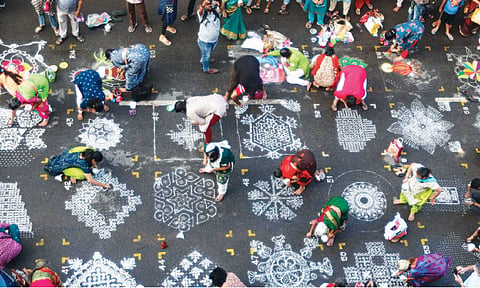

CHENNAI: Every January, the lanes of Mylapore burst into colour, music, and movement, transforming the quiet heritage neighbourhood into a living museum of Chennai’s art and culture. The Mylapore Festival has become a symbol of what the city stands for — rooted tradition meeting community spirit. But as magical as it is, one can’t help but wonder: what if Chennai could amplify this energy across the city, turning multiple neighbourhoods into hubs of art and celebration? With the right planning, the city could recreate the magic of the Mylapore Festival throughout the year, transforming itself into a continuous stage for culture.
To begin with, Chennai has the cultural depth and diversity to sustain several such events. From Triplicane’s agraharams to the colonial quarters of George Town, from Thiruvanmiyur’s temple streets to Besant Nagar’s beaches, every part of the city holds stories waiting to be told. Decentralising cultural festivals would not only revive heritage pockets but also engage local communities in preserving their neighbourhood identities.
To imagine this, inspiration can be drawn from the recently concluded Yi Peng Lantern Festival in Thailand. Each year, Chiang Mai’s night sky glows with thousands of floating lanterns, meticulously planned and beautifully coordinated. From crowd management and safety to environmental measures and tourist engagement, every aspect of the festival is handled with precision. What makes it shine isn’t just its beauty — it’s the balance of tradition, community, and organisation. That’s exactly what Chennai can aspire to achieve on its own cultural canvas.
The city already has the creative fabric — from the Margazhi Music and Dance Season and Chennai Sangamam to newer events like the Chennai Photo Biennale. These festivals draw thousands, yet remain fragmented in timing, location, and infrastructure. With better coordination, a unified “Chennai Cultural Circuit” could be created.
However, scaling up requires coordination more than enthusiasm. City planners and cultural organisations could collaborate with residents’ associations and colleges to curate themes unique to each area. Proper infrastructure is key: designated traffic management, waste segregation systems, clear signage, and dedicated spaces for performers and vendors would ensure that heritage is celebrated without chaos.
Corporates and hospitality players could also be roped in through sponsorships and CSR initiatives. After all, culture fuels tourism, and tourism fuels the city’s economy. Imagine a Chennai Cultural Circuit where visitors can explore folk performances in Saidapet, handloom fairs in T Nagar, culinary trails in George Town, and street theatre in Adyar — all under a unified cultural calendar.
Chennai has several such events that can be scaled to match its global aspirations. For instance, the city is upping its game with each Madras Day celebration. During the week, many organisations conduct photo walks, heritage walks, music and dance events, photo archive exhibitions, and film screenings. But these events are organised individually, which limits the possibilities when it comes to expanding their size and scope.
The day marks not just the birth of a city, but the establishment of the first ever municipal body in the world in 1688! Reducing it to disparate events is underselling the potential to brand as the birth of a modern city system. What is required is to bring them all together as events within a much larger, common umbrella event that can rival cultural festivals held in major cities across the world. If organised in a systematic way with better coordination, it would act as a branding for the city and also a source of community pride for its people.
The Chennai Sangamam event, which brings the essence of village life to the metropolis, should not be restricted to some areas in the city. Such events should be organised in every neighbourhood within the megapolis, both within the old city areas and also on the fringes. It should help us connect with our roots while also helping the artists, artisans, and others.
Next is Chennai’s Margazhi season, the vibrancy of which peaks with the raga of Carnatic music and ecstatic performances of Bharatanatyam exponents in December-January. Considering the competition and rivalry among them, it may not be easy to convince the traditional Sabhas to come together to organise a single event. But we don’t have to. What is required is to build a city that would gear up for the events at different Sabhas, enjoy the artistic competition between them, and serve it up as a blast from the past to the world.
From the lantern festival in Thailand to the Oktoberfest in Germany, there are several examples of using our cultural past as a tool to instill pride in the people. And while we are at it, it will also help earn a tidy revenue that would help boost the capital’s economy. Scaling these spirits across the city could make Chennai not only a hub of Carnatic music and temple architecture, but a living, breathing cultural capital that celebrates its heritage in every corner, every season, and every sound.