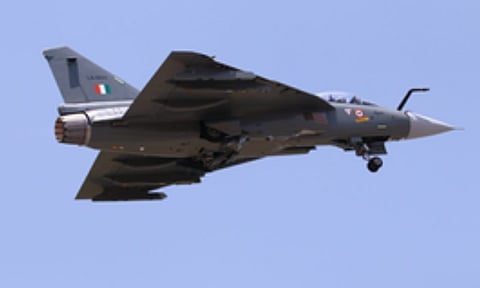

• The recent crash of an Indian Air Force (IAF) Tejas fighter aircraft at the Dubai airshow has put the country’s indigenous defence manufacturing programme under the probing global spotlight. It could cast a long shadow on its ambitious plans to not only reduce dependence on imports and gradually increase self-reliance but also to be a leading defence exporter to the Global South.
This unfortunate event does harm India’s interests in terms of optics and perception. But it would be an exaggeration to describe it as a major setback to the Light Combat Aircraft programme as a whole. In India’s defence, experts have rightly pointed out the impeccable safety track record of Tejas even after thousands of sorties for over two decades. However, what could overshadow this impressive safety record are the two crashes -- first in Rajasthan’s Jaisalmer last March and now in Dubai.
Accidental crashes during complex acrobatic manoeuvres at air shows are not rare either. So much so, there is a dedicated Wikipedia page with data for the years since 2001. Besides pilot error or technical malfunction, there could be other causes as well. It is incorrect to dismiss a platform as of poor quality and unsafe in view of a crash or two.
However, an accident of this kind at a high-profile air show is likely to be exploited by vested interests. Given the business rivalries in the multibillion-dollar defence market, such mishaps could be easily turned into a tool to cast aspersions on a country’s capabilities to develop and manufacture high-tech military and civilian flying machines.
India needs to have a strong global outreach system in place to counter such mischief through smart campaigns featuring credible Indian and international defence analysts and experts who could present the picture in the right perspective and substantiate with proven facts.
A more serious problem is the glaring gap between India’s claims and delivery. Speed has not been one of the attributes the Hindustan Aeronautics Limited (HAL) could boast of, especially in the context of development and production of Tejas. The government-owned aerospace and defence company and other stakeholders had missed targets due to various factors, some of which are, of course, justified.
For instance, GE Aerospace could not keep its word regarding the delivery of engines, and India could be having a tough time enforcing contractual obligations. Another reason is the challenges relating to the integration of different systems, which require technological expertise and experience.
The issue of delays had, in fact, spilled into the public domain when Air Force Chief Amar Preet Singh spoke his mind at a public forum. His indictment about making promises that cannot be fulfilled was damning when he revealed that projects are not completed on time.
Over-promising and under-performing can be managed to some extent in domestic politics, but not in the global manufacturing scene, especially in the high-stakes, ruthlessly competitive, closely-watched defence industry.
Part of the blame rests with the political dispensation and leadership for not setting realistic targets and for failing to get things done on time. The government in future should be more cautious and understated when it comes to making announcements which are of global interest or implications. Otherwise, it will be seen as bravado and misplaced pride, and the country will not be spared or seen sympathetically in the event of failure or misfortune.