
- Chennai
- Tamil Nadu
- India
- World
- EntertainmentEntertainment
- Business
- Sports
- Lifestyle
- Technology
- Videos
- Explainers
- Editor's Picks
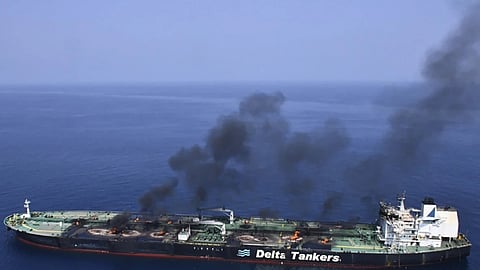
CAIRO: Yemen's Iran-backed Houthi rebels said they attacked two Saudi oil tankers in the Red Sea on Thursday, potentially opening a new front as the US military conducted its 12th night of strikes against Iran.
The Houthis have threatened to shut down another key trade route, with the world economy already reeling from Iran's closure of the Strait of Hormuz. Iran and the US have meanwhile stepped up their attacks as they vie for control of the strait, through which a fifth of the world's oil and gas passed in peacetime, setting off a scramble for alternative routes.
US President Donald Trump threatened “major military punishment” against the Houthis if their attacks on ships continue.
“If they do this again, the US will hold Iran responsible, in that the Houthis are a Surrogate and/or Proxy of Iran, and major military punishment will be inflicted upon Iran and, of course, the Houthis themselves,” Trump wrote on social media.
As the rhetoric escalated, so did the economic fallout. The price of a barrel of Brent crude oil, the international standard, spiked 4.3 per cent Thursday to USD 98.16, its highest level since early June, before the two sides reached a preliminary peace agreement that has since collapsed.
Prime Minister Ali al-Zaidi of Iraq, who has close ties to both the US and Iran, was in Tehran on Thursday to call for peace and dialogue, a spokesperson said. Al-Zaidi met with Trump earlier this month in Washington.
An Arab diplomat said Gulf states are increasingly pessimistic about finding an off-ramp. The diplomat, speaking on condition of anonymity due to the sensitivity of the situation, said regional countries, in addition to Pakistan and Turkiye, continue to push for de-escalation.
The Houthis' SABA news agency said the rebels had struck two tankers, the Encelia and the Layla, in the Red Sea, leading to fires on both. There were no reports of casualties.
It was their first reported attack on a vessel since they announced a blockade of Saudi-linked shipping through the Bab el-Mandeb Strait earlier this week in retaliation for the kingdom's blockade on Yemen and a recent attack on the international airport in Yemen's rebel-held capital, Sanaa.
Bab el-Mandeb, at the southern tip of the Arabian Peninsula, is a vital shipping chokepoint connecting the Red Sea to the Gulf of Aden. Around 12 per cent of the world's trade, including a fourth of global container traffic, passes through there, moving between Europe and Asia via Egypt's Suez Canal.
The state-run Saudi Press Agency reported an attack set the Encelia ablaze overnight in the Red Sea. It did not mention Layla.
The United Kingdom Maritime Trade Operations Centre, UKMTO, said it received a report of a tanker being struck by “an unknown projectile” 130 kilometres (80 miles) southwest of Al Shuqaiq, Saudi Arabia, in the Red Sea.
The Houthi attacks put at risk oil shipments from Saudi Arabia's Yanbu port on the Red Sea and present a “double whammy” on top of the disruption in the Strait of Hormuz, said maritime data and analysis firm Lloyd's List Intelligence.
Saudi Arabia has diverted millions of barrels a day of oil exports to Yanbu via an overland pipeline as the war has bottled up the Persian Gulf.
The Houthi threats “raise questions on the viability of this route,” Lloyd's said in slides accompanying an online webinar Thursday.
The rebels say they are blockading Saudi Arabia, but during their announced blockade of Israel, at the height of the war in Gaza, they targeted many vessels with little or no connection to that conflict, disrupting global trade.
Iran says it has the right to manage traffic and potentially charge fees in the Strait of Hormuz, which was open to all and toll-free before the war. It has attacked ships using a route through the strait that is overseen by US forces and intended to be outside Tehran's control.
In response to Iran's attacks, the US began the widening campaign of strikes across Iran and restored a naval blockade of Iran's ports.
The war of words has also escalated. Iran's Foreign Minister Abbas Araghchi said Tehran would adopt an “eye for an eye” policy on US strikes against its infrastructure. US Secretary of State Marco Rubio retorted that President Donald Trump's policy is “an eye for an eye.”
“The price will continue to get higher every single night until they come to their senses,” Rubio told reporters while travelling in the Philippines for a regional summit.
Iranian state media reported that US missiles struck locations overnight near the cities of Ahvaz, Ramshir and Andimeshk in western Iran, and two people were killed in a US missile strike in the town of Shalamcheh on the Iraqi border.
US Central Command said its strikes were designed to “further degrade Iran's ability to threaten civilian mariners and commercial vessels transiting regional waters,” as the Americans push to regain control over the Strait of Hormuz and restore the flow of international shipping.
Iran has responded to US attacks by targeting energy infrastructure and desalination plants providing drinking water in parched neighbouring Gulf countries.
Jordan said its military had intercepted three missiles early Thursday, with a fourth falling in an empty area, while six drones were intercepted Wednesday night. Bahrain's Interior Ministry posted on X that sirens had sounded and urged the public to remain calm and head to a safe area.
Kuwait's military said that drones had attacked its border crossing with Iraq, causing damage but no casualties. That attack may have been in response to the US strike on the Iran-Iraq border crossing.
