
- Chennai
- Tamil Nadu
- India
- World
- EntertainmentEntertainment
- Business
- Sports
- Lifestyle
- Technology
- Videos
- Explainers
- Editor's Picks
SEOUL: The head of the UN's nuclear watchdog said Wednesday that “very detailed” measures to verify Iran's nuclear activities must be included in a potential US-Iran agreement to end their war in the Middle East.
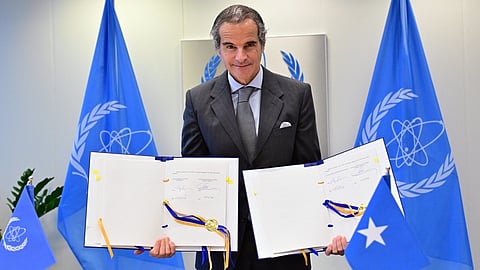
International Atomic Energy Agency (IAEA) Director General Rafael Grossi stressed the need for the thorough verification regime for Iran's nuclear programme, as US President Donald Trump said Tuesday that a second round of talks with Iran could happen over the next two days.
The Trump administration has said that preventing Iran from gaining a nuclear weapon is a key war aim. Iran has previously said it isn't developing such weapons but rejected limits on its nuclear programme.
Last weekend in Pakistan, an initial round of talks between the two countries failed to produce an agreement. The White House said Iran's nuclear ambitions were a central sticking point. But an Iranian diplomatic official, speaking on the condition of anonymity because of the sensitivity of the closed-door talks, denied that negotiations had failed over Iran's nuclear ambitions.
“Iran has a very ambitious, wide nuclear programme so all of that will require the presence of IAEA inspectors,” Grossi told reporters in Seoul. “Otherwise, you will not have an agreement. You will have an illusion of an agreement.”
He said that any agreement on nuclear technology “requires very detailed verification mechanisms.”
Iran has not allowed the IAEA access to its nuclear facilities bombed by Israel and the United States during a 12-day war in June, according to a confidential IAEA report circulated to member states and seen by The Associated Press in February.
The report stressed that it “cannot verify whether Iran has suspended all enrichment-related activities,” or the “size of Iran's uranium stockpile at the affected nuclear facilities.”
Iran has long insisted its programme is peaceful, but the IAEA and Western nations say Tehran had an organised nuclear weapons programme up until 2003.
The IAEA has maintained Iran has a stockpile of 440.9 kilograms of uranium enriched up to 60 per cent purity, a short, technical step away from weapons-grade levels of 90 per cent.
That stockpile could allow Iran to build as many as 10 nuclear bombs, should it decide to weaponise its programme, Grossi said earlier.
Such highly enriched nuclear material should normally be verified every month, according to the IAEA's guidelines.
During Wednesday's press conference, Grossi also said his agency has confirmed “a rapid increase” in activities at nuclear facilities in North Korea. His comments echoed a view by many foreign observers that North Korea has taken steps to expand its main Yongbyon nuclear complex and build additional uranium-enrichment sites since its diplomacy with the US collapsed in 2019.
Last September, South Korea's Unification Minister Chung Dong-young said that North Korea was operating four uranium enrichment facilities and that they were running everyday.
