
DUBAI: President Donald Trump warned the US will "obliterate" Iran's power plants if it doesn't fully open the Strait of Hormuz within 48 hours, prompting Tehran to say it would respond to any such strike with attacks on US and Israeli energy and infrastructure assets.
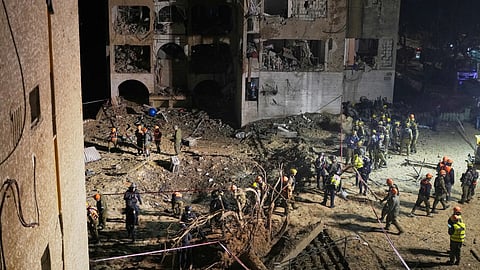
Iranian missiles, meanwhile, struck two communities in southern Israel late Saturday, leaving buildings shattered and dozens injured in dual attacks not far from Israel's main nuclear research centre.
The developments signalled the war was moving in a dangerous new direction at the start of its fourth week.
Trump -- who is facing increasing pressure at home to secure the strait as oil prices soar -- issued the ultimatum in a social media post while he spent the weekend at his Florida home.
The death toll from the war has risen to more than 1,500 people in Iran, more than 1,000 people in Lebanon, 15 in Israel and 13 US military members, as well as a number of civilians on land and sea in the Gulf region. Millions of people in Lebanon and Iran have been displaced.
The Qatari Interior Ministry said one person is still missing from the crash on Saturday in the Persian Gulf country's territorial waters.
A ministry statement on Sunday didn't clarify the nationality of the dead or say if they were civilian or military.
The Defence Ministry blamed a "technical malfunction" for the crash.
Ministry spokesman Hossein Kermanpour says the evacuations from the Imam Ali Hospital in the southwestern city of Andimeshk came after an airstrike a day earlier.
"Suffering patients in the city of Andimeshk were forced to leave the only hospital in the city," Kermanpour wrote on X.
He posted images showing a hospital ward with a partially collapsed ceiling, a corridor with broken glass, and debris scattered across the floor.
Kermanpour said the patients have been evacuated to another city.
Israeli security minister Itamar Ben-Gvir is visiting the southern town of Arad, where dozens of people were hurt by a missile strike overnight. The hard-line national security minister says Israel is waging a "historic battle" against Iran and that it must "continue until victory".
The government said the decision was made due to soaring global oil prices and as the country's stocks have depleted due to panic buying in recent weeks.
With the latest increase, the second in two weeks, local fuel prices have gone up by about one-third since the war in the Middle East started.
The island nation has taken up other measures including strict fuel rationing system and closing of schools, universities and government offices on all Wednesdays.
Long lines of vehicles still persist at fuel stations across the country.
Air defences early Sunday tracked the launch of three ballistic missiles toward Saudi Arabia's capital, Riyadh, intercepting one, while the other two fell in an uninhabited area, according to the Defence Ministry.
The ministry also said it downed six drones headed toward the kingdom's eastern region, one of its least densely populated areas near Iran and home to major oil installations.
No casualties or damage were immediately reported.
A projectile struck close to a bulk carrier off the coast of the United Arab Emirates, causing an explosion, the British military's United Kingdom Maritime Trade Operations centre said early Sunday.
The attack occurred about 15 nautical miles north of Sharjah in the UAE.
The UKMTO said the ship's crew was safe.