
- Chennai
- Tamil Nadu
- India
- World
- EntertainmentEntertainment
- Business
- Sports
- Lifestyle
- Technology
- Videos
- Explainers
- Editor's Picks
DUBAI: Airstrikes battered Iran's capital and Iranian missiles and drones targeted Israel's Tel Aviv and sites across the Mideast on Tuesday, even as President Donald Trump said the United States was in talks with the Islamic Republic to end the war.
With thousands more US Marines on their way to the Gulf, both sides firing intense barrages and Iran denying any negotiations are taking place, the war's tempo remained high a day after Trump delayed his self-imposed deadline for Iran to reopen the Strait of Hormuz. Tehran's chokehold on that crucial waterway has snarled international shipping, sent fuel prices skyrocketing, and threatened the world economy.
Any talks between the US and Iran which appeared at the most tentative on Tuesday would face monumental challenges. Many of Washington's shifting list of objectives particularly over Iran's ballistic missile and nuclear programs remain difficult to achieve. Meanwhile, it's not clear who in Iran's government would have the authority to negotiate or be willing to, particularly as Israel has vowed to continue taking out leaders after killing several.
Iran also remains highly suspicious of the United States, which twice, under the Trump administration, has attacked during high-level diplomatic talks, including with the Feb. 28 strikes that started the current war.
Iran's military has conducted strikes on the orders of local commanders, rather than from the political leadership, Foreign Minister Abbas Araghchi said early in the war. It remains unclear whether Iran's new Supreme Leader, Mojtaba Khamenei, who reportedly was wounded and has yet to be seen publicly, is issuing orders to Iran's regular military or its paramilitary Revolutionary Guard, which answered only to his late father.
While Iranian parliament Speaker Mohammad Bagher Qalibaf called the idea of negotiations with the US “fake news,” Araghchi's office acknowledged the foreign minister has been talking about the war this week with his counterparts in Azerbaijan, Egypt, Oman, Pakistan, Russia, South Korea, Turkey and Turkmenistan.
Talk of negotiations briefly drove down oil prices and boosted stocks. But that respite was short-lived, with the price of Brent crude, the international standard, nudging back over USD 100 a barrel Tuesday, up nearly 40 per cent since the war started.
Iran's leaders are wary of Washington's motives, in part because Tehran was in negotiations with the US before the surprise attack that started the current war. Iran was also in talks last year when the US and Israel attacked its nuclear facilities.
Iran named a former Iranian Revolutionary Guard commander as the new secretary of the country's Supreme National Security Council on Tuesday, replacing Ali Larijani, who was killed in an airstrike. Iranian state television identified the new secretary as Mohammad Bagher Zolghadr, who reached the rank of brigadier general in the Guard.
Trump's announcement also comes as a contingent of thousands of Marines is on the way to the region, raising speculation that the US may try to seize Kharg Island, which is vital to the country's oil network.
The US bombed the island in the Persian Gulf more than a week ago, hitting its defences but saying it had left oil infrastructure intact.
Iran has threatened to mine the Persian Gulf if the US appears to be on the verge of landing troops. That would complicate an amphibious assault and also imperil all shipping in the area.
Trump said he would hold off on a threat to bomb Iran's power stations while talks unfold a delay that could be timed to coincide with the arrival of US Marines in the region, expected Friday, wrote the New York-based think tank the Soufan Centre in an analysis.
“As Trump has in the past, he could be moving military assets into place, in this case to prepare for an invasion and seizure of Kharg Island, while using negotiations as a cover until those assets are fully combat-ready.”
However, the centre also noted that “Trump could be actively seeking an offramp. Whether Iran reciprocates is yet to be seen.”
Trump has said he has no plans to send ground forces into Iran but has not ruled it out. Israel has suggested its ground forces could take part in the war.
As airstrikes hit Tehran, Iran fired multiple waves of missiles at Israel early on Tuesday.
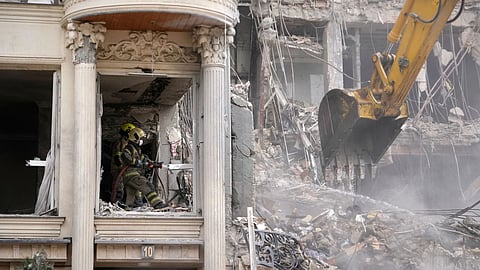
In Tel Aviv, a missile with a 100-kilogram (220-pound) warhead evaded Israeli defences to slam into a street in the centre of the city, blowing out windows of a neighbouring apartment building and sending smoke billowing. Four people suffered minor wounds, rescue service worker Yoel Moshe said.
Emerging from a shelter, Amir Hasid said he expected the scene to be far worse. “It feels like you're a (sitting) duck, waiting for the missiles to hit you, or someone next to you,” he said.
In Kuwait, power lines were hit by air defence shrapnel, causing partial electricity outages for several hours. Missile alert sirens sounded in Bahrain, and Saudi Arabia's Defence Ministry said it had destroyed 19 Iranian drones targeting its oil-rich Eastern Province.
Israeli Prime Minister Benjamin Netanyahu, meanwhile, said Israel will continue to strike Iran and Lebanon even as the US considers a ceasefire.
“There's more to come,” he said.
Israel pounded Beirut's southern suburbs on Tuesday, saying that it was targeting infrastructure used by the Iran-linked Hezbollah militant group.
A strike on a residential apartment southeast of the Lebanese capital killed at least three people, including a 3-year-old girl, according to the Lebanese Health Ministry. Another five people were killed in the south.
Meanwhile, Lebanon ordered Iran's ambassador to leave by Sunday, declaring him persona non grata. Foreign Ministry spokesperson Denise Rahme told The Associated Press that Iran's embassy will still have a charge d'affaires to head its diplomatic mission.
The Lebanese government has been critical of Iran and accuses its elite Revolutionary Guard of operating in Lebanon alongside the Hezbollah militant group, and dragging the country into another war with Israel.
Israel has said that some of its strikes have targeted Guard officials operating in the country.
Authorities say Israeli strikes have killed more than 1,000 people in Lebanon and displaced more than 1 million.
Iran's death toll has surpassed 1,500, its Health Ministry has said. In Israel, 15 people have been killed by Iranian strikes. At least 13 US military members have been killed, along with more than a dozen civilians, in the occupied West Bank and Gulf Arab states.
